
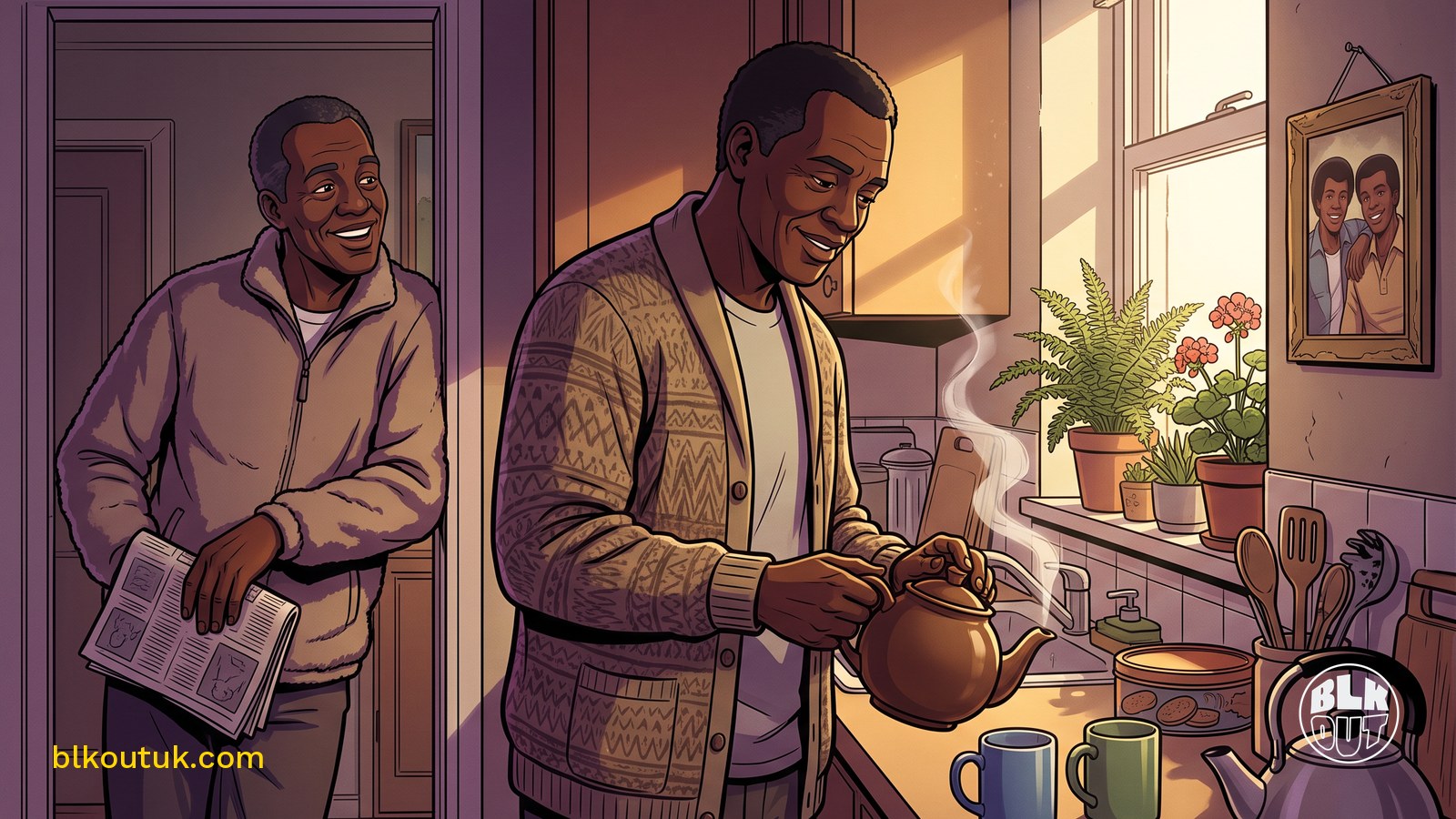
In the 1990s, Big Up looked for us in the gay press. Dennis Carney remembers the research: every image of a Black man the team could find, over four weeks. There were four. A Black man "with a big thing between his legs". A Black man and a white man "looking lovingly into each other's eyes". A Black man in sunglasses. A Black man in a dress, a wig and high heels. "And they were the only four images that we could find. And we never saw any images of black men loving black men" (Ep. 76, 15:08).
Dennis had Joseph Beam in his head when he said it: "black men loving black men is a revolutionary act" (Ep. 76, 15:23). Thirty years on, he still thinks love is the thing that goes missing whenever we are discussed: "the word that gets missed a lot when black queer men are talked about in any way, is this four letter word, L-O-V-E, love" (Ep. 76, 9:34). For him it was never an abstraction. "It was the love of another man that brought my awareness of my sexuality, falling in love with another guy" (Ep. 76, 9:46).
bell hooks wrote about love as "the practice of freedom", in an essay of that name in Outlaw Culture (1994). Her point was that love is not a feeling that happens to you. It is a set of things you do, again and again, with other people, and it can be learned. Listening to these conversations, that is what I heard. Nobody describes love as a mood. They describe it as work they did, and a home they made.
A man, a home
Martin Patrick is nearly seventy. "74 would change everything because I met the man who would be my hubby for the next 20 years in 1974. I was just a teenager and it was illegal according to British law" (Ep. 122, 16:11). Twenty years, begun under a law that said it shouldn't exist. What it gave him he puts plainly: "In my 20s I was in love. I had a man. I had a home. And I had things that were mine" (Ep. 122, 25:34).
He also says what is still missing from the way we are written about: "We talk about queer politics today, but what I'm still not reading about is the love that men have for each other … is to me intrinsically bound with respect. That's the everything that incites the eroticism that becomes your private life" (Ep. 122, 29:28). Respect first, and desire coming out of it. That is a practice, not a romance.
Lloyd Young, who spends his working life with people who have been harmed, describes a campfire at Black Experience where the men toasted each other's achievements. Among them: "celebrate achievement by being intimate with someone for a length of time" (Ep. 127, 15:39). Staying with someone counts, in that circle, alongside a degree or a promotion. It should.
Practice can also mean honesty at the start. Eric Yassine describes meeting the woman who became his wife: "The first time I met her I told her hey I sleep with women yeah but I also sleep with men and she was, do your thing" (Ep. 96, 20:24). Love built on telling the truth on day one is a different thing from love built on hiding.
Not instead of sex
Erick, the host, asks Dean Atta a fair question: "Why does our existence get boiled down to what we do in intimate moments?" (Ep. 109, 20:46). The guests' answer, across the series, is not to talk about sex less. It is to say love alongside it.
Dennis again: "it's really important, especially as Black queer men that we are sex positive, we talk about the sex that we have positively, because it's talked about so negatively outside of our world" (Ep. 76, 10:57). Marc Thompson, who has spent decades in HIV prevention, refuses the respectable version of equality. Seeing white gay men pushing prams in Brockwell Park, he jokes with younger colleagues: "I didn't fight for that" (Ep. 74, 39:05). What he did fight for: "We radically love each other and not have heteronormative lifestyles" (Ep. 74, 39:11). Shaun Wallace says it more simply: "I love Black men, I think Black men are beautiful" (Ep. 3, 41:55).
And Dean makes the images Big Up couldn't find. Of his animated film, he says he wanted "a world where this safety and joy and unadulterated love is possible between two black gay men" (Ep. 109, 22:57). The team first covered the figures' genitals, then changed their minds: "we're talking about being an Eden and being free. And so we should be able to show their penises. Like, it's not a big deal" (Ep. 109, 24:55). Four images in four weeks in the 1990s. Now we make our own.
The part we're still learning
If love is a practice, it can be practised badly, and the guests are honest about that too. Adé Adeniji describes years of trying to earn it: "I needed to hustle for it by perfecting, by proving, by performing, by showing up in a different way so that people would then love me" (Ep. 49, 11:38). That is love as a wage rather than a gift, and he names it so he can stop.
I said something on tape that I still think about: "the way in which we socialize to avoid intimacy to avoid things that we know are good for us" (Ep. 65, 24:53). I meant it about us, not about other people. We are very good at being in the same room. We are less practised at being close in it.
Love as practice means it is not a gift some of us were born with and others missed. It is something we learn, from elders like Martin and Dennis, from artists like Dean, from each other, and get better at by doing it. Shaun gives the reason to bother: "And I want to see love as well. See love is the fabric of it all" (Ep. 3, 39:08).