
In 1926, Langston Hughes wrote the foreword to Fire!! magazine with words that still burn bright: "We … who create now intend to express our individual dark-skinned selves without fear or shame... We build our temples for tomorrow, strong as we know how." That radical — short lived — magazine — edited by Wallace Thurman, with contributions from Zora Neale Hurston, Aaron Douglas, Richard Bruce Nugent, and Hughes himself — represented Black queer experimentation at its most audacious. It was cultural insurgency dressed as a literary journal, performance disguised as print. A century on its radical rejection of respectability, in favour of the ‘messy truth’ continues to reverberate.
To understand Black queer movements is to understand futurity as praxis. Black feminist thought has long insisted that the work of liberation is inherently future-oriented — not in some distant, utopian sense, but in the everyday act of imagining otherwise. For those at the intersections of race and sexuality, this imaginative labour isn’t theoretical luxury; it’s survival strategy. We dream forward because the present was never designed with us in mind.
Necessity, as the saying goes, is the mother of invention. When mainstream institutions refuse to see us, we build our own stages. When algorithms flatten our complexity, we create new architectures of connection. We invent, we reinvent, we dismantle, we re-purpose, not necessarily in that order! Black queer organisers have consistently been at the vanguard of social change — not despite our marginality, but because of it. Oftentimes, like Bayard Rustin, our contributions are made away from the limelight, or like the Black Lesbian voices of the Combahee River Collective, in the subtext. It is clear though, that the view from the margins offers clarity that the centre struggles to perceive.
The evidence is everywhere if you know where to look. In dance, Berto Pasuka and Richie Riley pioneered new vocabularies of movement in Britain, while across the Atlantic, Alvin Ailey transformed American modern dance into a testament of Black experience and spirituality. In music, Ken Johnson brought jazz to British audiences as a bandleader who understood that cultural innovation crosses oceans. Sylvester’s falsetto rewrote the possibilities of disco, his voice an act of liberation in itself. And in the warehouses of Chicago and New York, Frankie Knuckles and Larry Levan didn’t just create house music — they built sanctuaries where Black and queer bodies could move freely, where the dancefloor became a site of collective transcendence. These weren’t isolated acts of genius; they were expressions of communities creating the conditions for their own joy, plotting courses to liberation. The House of Labeija, in holding space for outcasts to become home for each other, built space for Paris Dupree to burn the dancefloor, and Willi Ninja to bring vogue into vogue.
The reach of Black queer innovation extends far beyond culture into the machinery of the state itself. Consider Ivor Cummings, who in 1948 carved out a role as the first Black civil servant in the Foreign and Colonial Office. Within six months of that year, his decisions would shape history in ways few have fully reckoned with: he welcomed the Empire Windrush to Tilbury, his administrative choices making Brixton the epicentre of British Black communities; and his refusal to accept the colour bar in British colonial Nigeria sparked riots in Lagos that forced the official end of that racist policy. One man. Six months. The trajectory of nations altered. This is what happens when Black queer people gain proximity to power and refuse to wield it according to the old rules.
Consider too the Movement for Black Lives, which emerged from the organising genius of three Black queer women: Alicia Garza, Patrisse Cullors, and Opal Tometi. Their deployment of digital tools for political mobilisation rewrote the rules of twenty-first century activism. They understood something fundamental: that technology is never neutral, but can be bent toward liberation when wielded by those who understand both its possibilities and its perils.
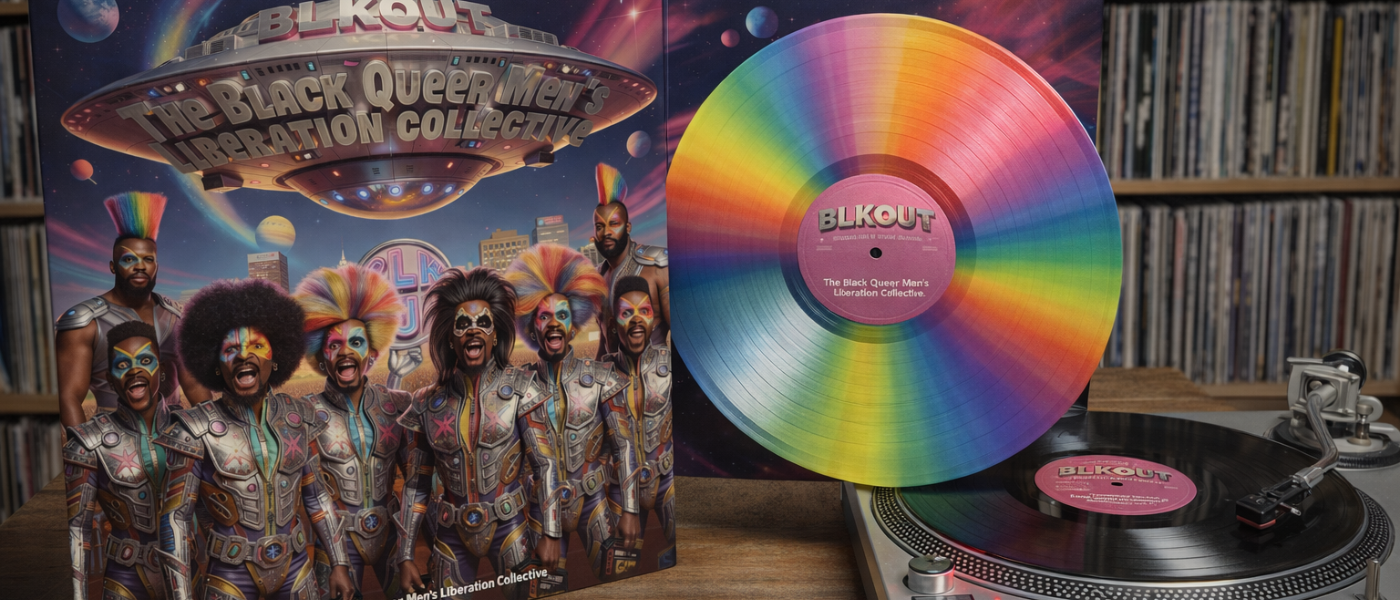
At BLKOUT, we’ve embraced what we are calling ‘liberation technology’ — the deliberate use of digital infrastructure to chart routes toward radical futures. This isn’t about chasing the latest platform; it’s about building systems that serve community rather than extract from it. We do not need to be fixed, we may be bowed, but we are not broken. For us, this means embedding our values into our tools: co-ownership structures that distribute power rather than concentrate it, distributed leadership that trusts the wisdom of the collective, collaboration over competition, and systems thinking that recognises how every node in our network strengthens the whole. When Aymar Jean Escoffrey, co-founder of OTT streaming channel OUTtv and Professor at Northwestern University, proposes ‘The Cookout’ as a model for Black digital media that is more than an entertaining corner of Twitter, he’s pointing toward something profound: the resurrection of ancestral gathering practices in digital form. The new contains the old. What the axe forgets, the tree remembers.
This is the essence of decolonising media — not merely representation within existing structures, but the creation of new structures altogether. Reparative media i.e. Black media recognises that what was taken can be rebuilt, often in forms more resilient than before, with a purpose that makes sense for us now. It is not enough to supplant the tech bros as they race to the bottom of a focus-debilitating attention economy; not enough to ‘win’ at YouTube or TikTok; not enough to eke out a melanated slice of the studio industrial complex, to become #UsToo in a #MeToo situation, not enough to be Black and beloved on Love Island or be the most faithful faithful in the castle. In this 100th year of Black History commemoration in the US, (next year marks 40 years for the UK), we should take time to consider not just the evidence of our existence but the lessons we might learn from it — and demand more from our civil society organisations; media included.
Innovation doesn’t happen in a vacuum. Research tells us that creativity flourishes under specific conditions: psychological safety, where people can take risks without fear of ridicule; diverse teams where different perspectives collide and combine; freedom to fail and learn; open communication; and crucially, time and resources to experiment. These conditions don’t emerge by accident — they must be cultivated with intention. For Black queer movements, this means creating spaces where our full selves can show up, where our wildest imaginings are met not with scepticism but with curiosity. It means funding not just projects but people, not just outcomes but processes. It means trusting that when we resource our communities, innovation follows. It requires those who hold our trust to demonstrate integrity.
As Audre Lorde urged us: "We must recognize and nurture the creative parts of each other without always understanding what will be created." This is a radical proposition — to invest in one another’s potential without demanding a business case, to support the dreamer before the dream takes shape. The need has never been greater. In times of retrenchment and backlash, our capacity to imagine and build otherwise is not optional; it is essential.
As we organise, we are also archiving. The information revolution that we are witnesses to makes this task easier and more challenging at the same time. Every campaign, every gathering, every digital tool we fashion becomes part of a legacy that future generations will inherit. Lorde also reminded us that "survival is not an academic skill" — a warning that resonates deeply for those of us who toggle between theory and practice daily. We do not have the luxury of being armchair theorists, debating liberation in abstraction while our communities navigate daily precarity. Nor do we get to take the ball home when we tire of the game, there is a legacy worth sharing.
The temples we build today may be servers and platforms as much as physical spaces. They may be WhatsApp groups and encrypted channels as much as retro zines or photocopied pamphlets. But they are temples nonetheless — sacred spaces where Black queer futurity is not merely imagined but actively constructed.
We have a future to build. And we’re building it now.
Join us.
Dr Rob Berkeley
January 2026