Let me start by admitting the obvious, which is that I like it.
Instagram asks almost nothing of you. No fee, no gatekeeper, no proposal to a funding panel, no website to commission. You make a picture, you write a line under it, and it is out in the world in under a minute. For an organisation with no money and a lot to say, that is not nothing — it is the lowest bar to entry that Black queer organising in this country has ever had. My predecessors were photocopying flyers and paying for postage.
And it is a delight, often. The scroll is genuinely hopeful. Somebody's cousin in Manchester doing something magnificent with a wig. A poet in Lagos I would never otherwise have read. Our own people, looking gorgeous, at things we made. When we built the picnic campaign — forty-seven posts, six weeks, a whole visual language invented for the run — I enjoyed nearly every day of it. There is real creativity being dangled, and we took it, and it was fun.
I notice we never actually decided to. There was no meeting. Nobody assessed it. We just found ourselves living there, the way you find yourself living in a city you moved to for one job. (TikTok, for the avoidance of doubt, is another planet as far as I am concerned, and I say that as a man of a certain age — aware of how that sentence sounds. In my defence I thought it would never catch on!)
So this is not a piece about a wicked platform and our innocence. It is about three quite reasonable things I want, and what the machine does to each of them on the way.
By the week before the picnic, incidentally, we were not halfway to our sign-up target.
---
I. I wanted to tell you about something I thought you'd like
That is the whole ambition. There is a thing happening in a park, you might enjoy it, here is where and when.
1. Nothing can travel. Links in captions do not work. "Link in bio" is a folk practice we invented to route around a deliberate design, and it converts about as well as shouting an address across a car park. Worse, there is no way to pass someone else's post to your own followers — no retweet, no share carrying the original. So I cannot amplify you and you cannot amplify me. Look at what they are saying, listen to them — the gesture that built every movement I have been part of — has no button.
2. Barely anyone sees it anyway. Organic reach for branded posts sits below 3.5%; Facebook pages nearer 2%, down from 16% in 2012. Of every hundred people who raised their hand and said keep me posted, fewer than four hear from us. The rest have to be bought back. I do not think most people realise this. I did not, for an embarrassingly long time — I thought we were being ignored, when actually we were not being delivered.
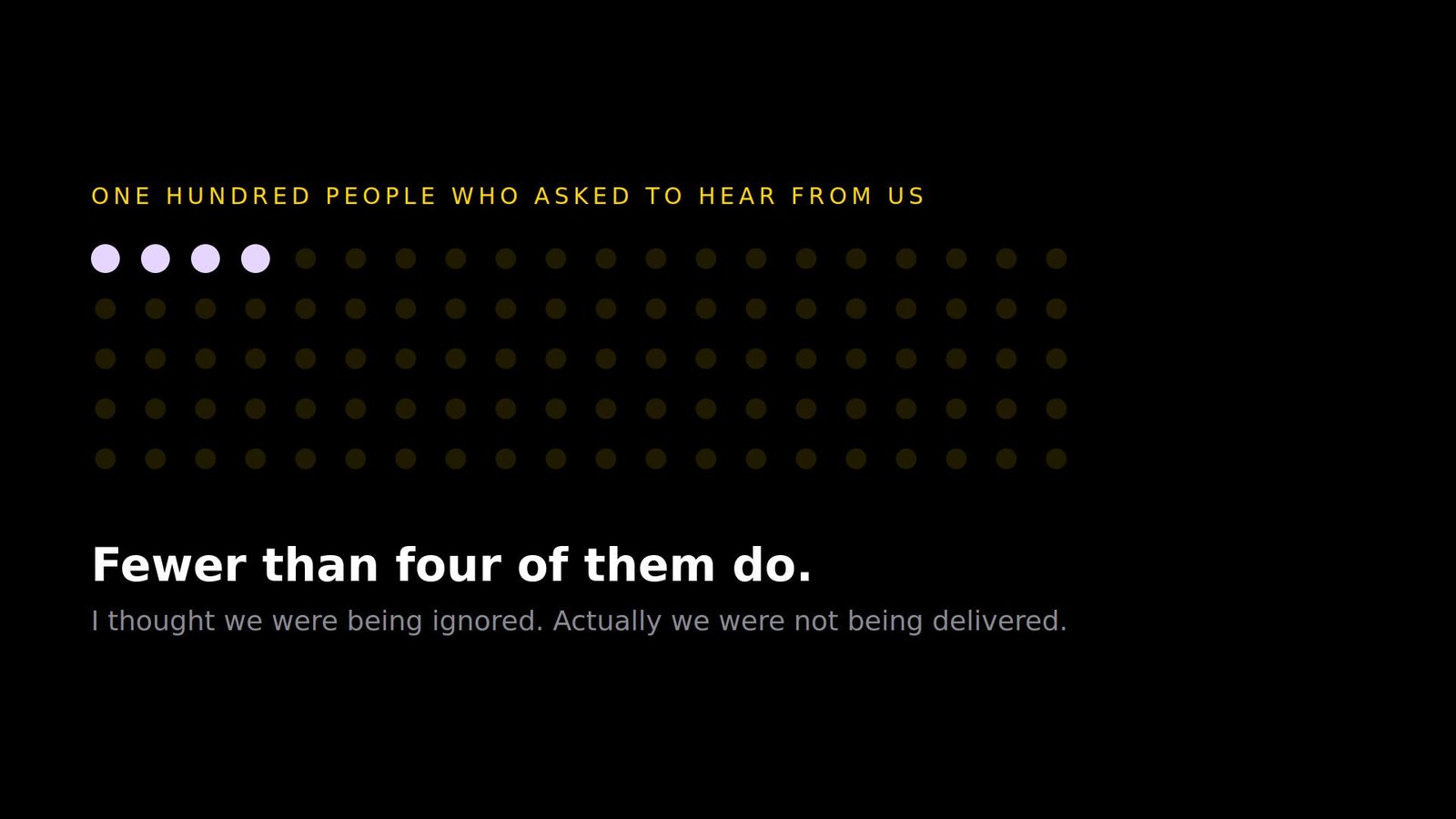
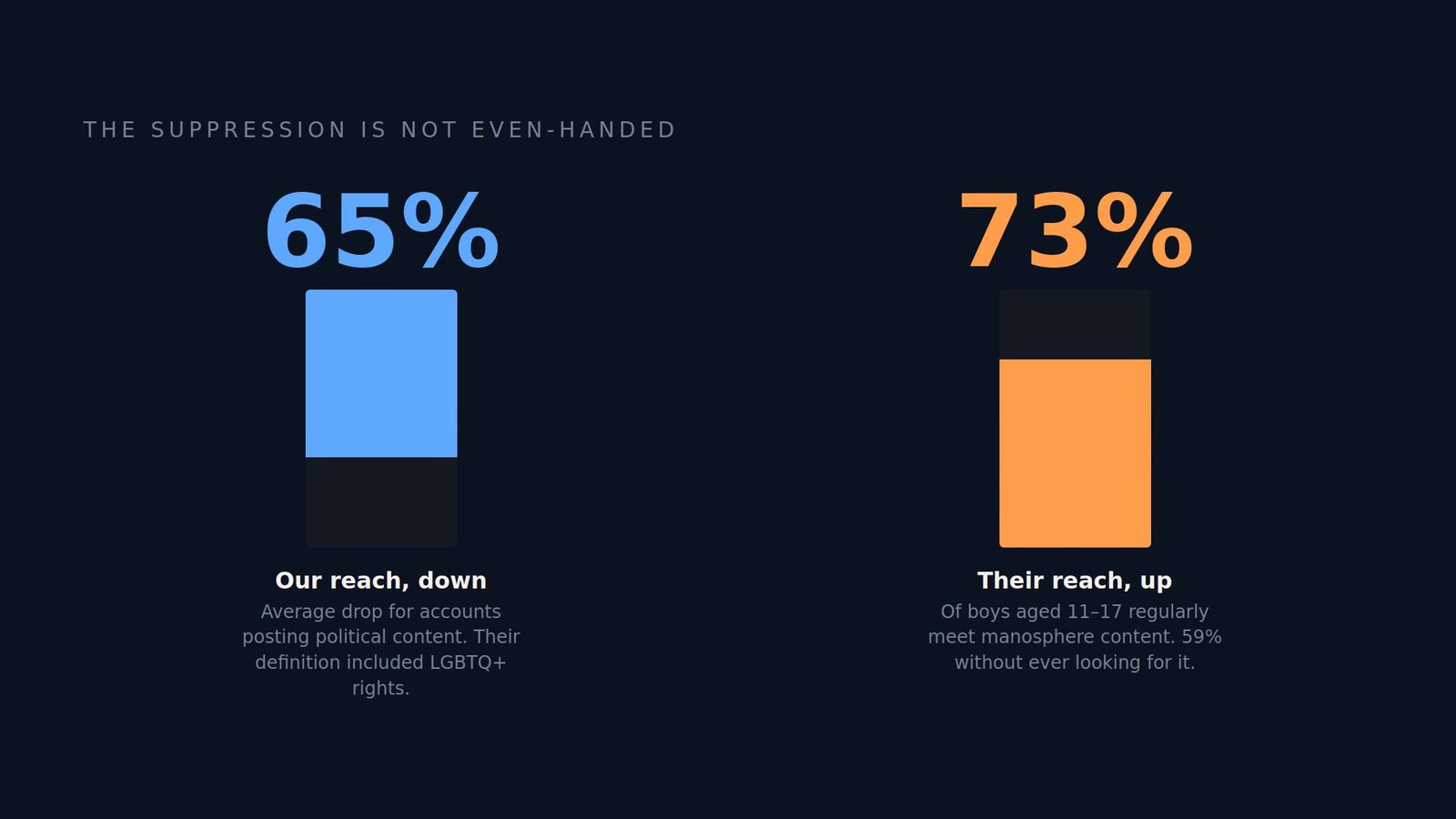
3. And our subject matter is filed under "politics". In February 2024 Meta stopped recommending political content by default; that June it overrode the settings of people who had opted in. Accountable Tech measured an average 65% drop in reach for accounts posting credible political content. Their definition of "social topics" explicitly included LGBTQ+ rights. So a Black queer organisation mentioning an anti-LGBTQ bill in Ghana is something to be quietly de-recommended. Nobody sent us a letter. You would only find out by noticing that fewer people came.
4. And I cannot simply tell you. No dependable way to reach the people who follow us and say the location has changed, it is raining, we start at two. Requests land in a folder nobody opens. Thousands of relationships and no working channel to any of them. What I get instead is a number of taps — which costs nothing, means nothing reliable, and feels like something. So we optimise what we can see, and what we can see is applause.
Four obstacles between "there's a picnic" and "you know about the picnic". None of them are anybody's fault in particular, which is rather the point.
---
II. I want you and me to be safe
This is the part where I stop being rueful.
5. What gets turned down for us gets turned up for the people who hate us. The Institute for Strategic Dialogue found mainstream commentary acting as a gateway into recommendations for anti-feminist, misogynist, anti-trans and incel content — one pipeline, converted into a sewer, and our trans siblings are on the receiving end of it. A 2024 study found TikTok and YouTube pushing manosphere material at accounts registered male within twenty-four hours, unsearched. Research cited by UN Women UK this year: 73% of boys aged 11 to 17 meet it regularly, 59% without ever looking.
Nobody conspired. Contempt is simply better engagement than care. Outrage is cheap to make and travels without friction; a picnic is expensive to make and returns nothing the machine can price. The manosphere did not invade this soil — it grew in it. And the campaign against trans people is not fighting the algorithm. It is using it exactly as designed.
6. I often cannot tell who I am talking to. Bot farms, sockpuppets, astroturf dressed as feeling, state operations that find small contested communities cheap to destabilise. Debate assumes someone with something at stake who might persuade you. Without that it is not debate, it is a wind tunnel — and a community that cannot tell an opponent from a paid account cannot deliberate. It can only react, and reaction is the product.
At the smaller end it is simply wearing, because the same anonymity walks straight into the inbox. So yes, anonymous, you can ask me whether white people are welcome at the picnic — but not whether I can help you procure "some BBC" as a follow-up.
7. And the private alternatives are not as private as they feel. Somebody always says just make a group chat. WhatsApp is Meta too, same landlord, smaller room — but that is not the main thing. Everybody's phone number is visible to everybody else, and in a community where plenty of people are not out to family or work, that is a safeguarding question rather than a preference. It also, as we both know, ends the same way: lovely for nine days, then muted, then archived, then a man none of us can place posting dick pics at two in the morning, and by Christmas it is deleted. Have the group chat. Just do not mistake it for somewhere safe, or for infrastructure.
---
III. I am trying to spend what little we have well
Not on principle. On arithmetic. We are a small organisation with a lot to do, and I would rather what we have went to us than into a billionaire's quarter.
8. It pays the influencer and starves the institution. There is a monetisation model; it is just not for us. The platform can make an individual rich and cannot make an organisation solvent — so the rational move, if you are talented and Black and queer and twenty-three, is to become a brand. I do not blame anyone who takes that door. I blame it being the only one. Watch what it produces: cloning, because a format that worked gets repeated until it dies; clickbait, because the first two seconds are the economy; the controversialist, because a fight beats a fact. Trust is the raw material being burned.
Meanwhile what we actually need is ownership, surplus, an asset lock. You cannot own a follower count, put reach in a reserve, or leave a legacy of impressions.
9. We rent the relationships, and pay rent to use them. Our followers are not ours to reach — we cannot export them, email them, or take them anywhere, and if the account went tomorrow they would go with it. And to make our own content reach our own accounts, we pay a subscription to an automation service. Our words, our images, our audience, our labour, and a monthly fee to a fourth party so the pipes connect.
10. Then it forgets, and trains on what it forgot. Nothing here is built to be returned to: lives vanish, captions cannot be edited, the past is disposed of rather than archived. Meanwhile Meta uses public posts, photos and captions to train its AI — in the UK you may object, if you know the setting exists and go looking. Most people do not. The reach is turned down and the harvest is turned up, and you can hold both facts without needing a conspiracy to join them.
We have run this experiment before, and it cost more than a picnic. Black Twitter was the most consequential Black public sphere the internet has produced — it set news agendas, made careers, built language the culture then borrowed, turned hashtags into movements that changed law. A decade to build, and it belonged to none of us. One change of ownership in October 2022 and it came apart in months: a racial epithet running at 26,000 instances in the week after the sale, three times that year's average; 115,000 deactivations in a single day. The archive, the relationships, the authority of ten years — none of it could be carried out of the building.
We watched a public sphere we made get switched off by a purchase. Then most of us rebuilt on land owned by a different billionaire. Including, for the avoidance of doubt, us.
---
What is coming, and why Meta should be nervous
Meta has launched Vibes, a feed made entirely of AI-generated content. Not assisted. Generated.
Their moat was never the software — anyone can build a feed. It was us: the fact that your cousin, your ex, your barber and your people were already there. Fill the room with machine-made content and the reason to be in it evaporates, and the switching cost goes with it. They are busy replacing the one thing that made them impossible to leave.
The market has noticed. "AI slop" mentions rose ninefold in 2025. Engagement drops around 12% when audiences identify content as AI-generated, and nine in ten people say they want transparency. Read those two together and the problem announces itself: the penalty lands at the moment of discovery — not when people are told a machine was involved, but when they find out and nobody said.
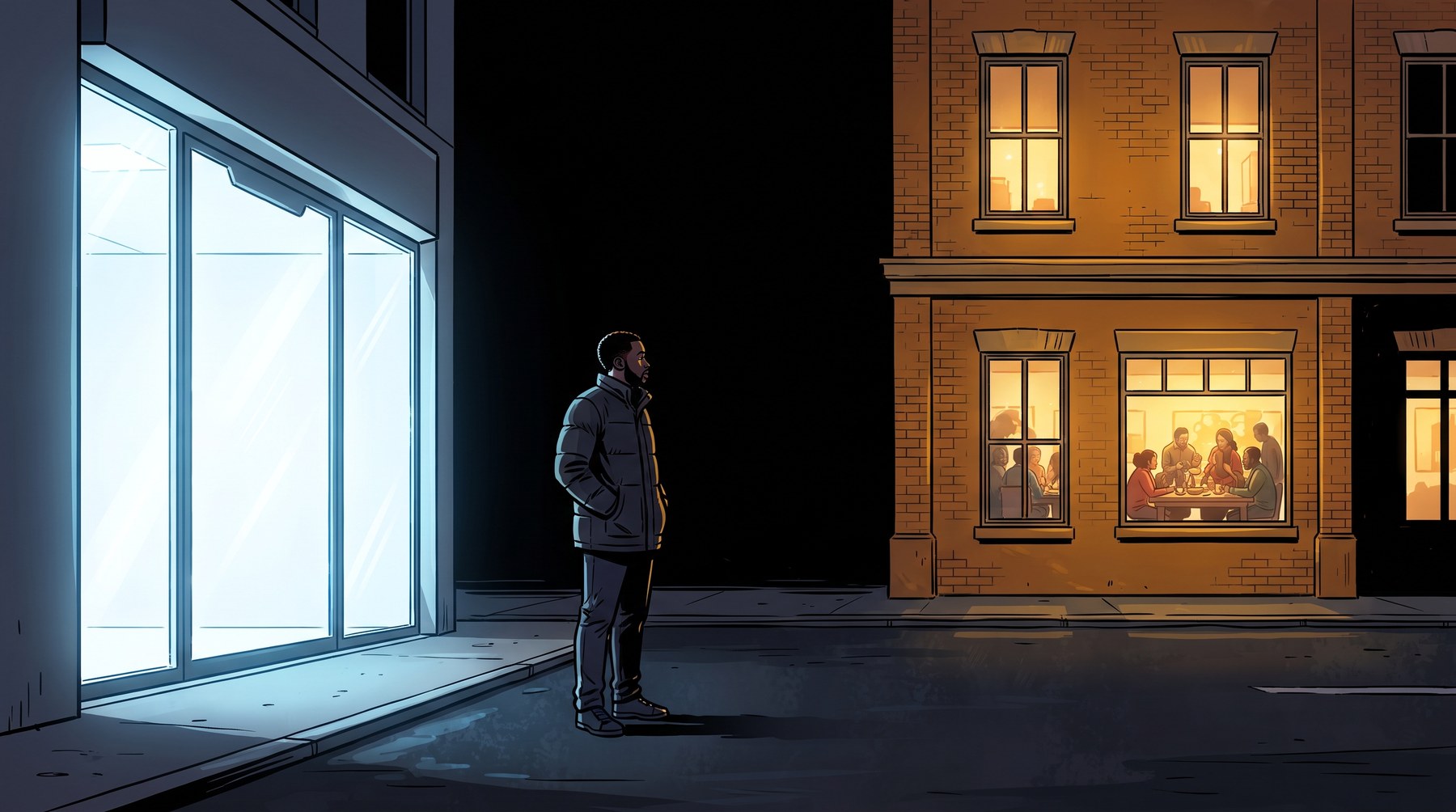
Which I should be exact about, because we use these tools, and the picture at the top of this piece is one of them. We are not against AI. We are against AI masquerading as testimony: a face that never existed grieving a thing that never happened, a review by nobody, a crowd who were never in the room. The harm is the counterfeit, not the tool.
And that is where it turns. Once a feed fills with things pretending to be somebody's life, the scarce thing becomes whatever can prove it is real — an event with a date and a postcode, a person who answers, an organisation you can turn up to on a Sunday and complain to in person. Which is what we have, and what a model cannot manufacture.
So what do we do, given we are not leaving
Not a boycott. That is a posture, and we do not have the reach to make one hurt anybody.
Not everywhere either, which is the question people actually ask: why aren't you on Reddit, Threads, Bluesky? Because every platform is a tenancy and every tenancy has to be tended — its own formats, its own interface breaking in its own particular way, its own rules changed without notice and relearned on our time. That cost is not incidental. A compliance burden a corporation absorbs with a team of six removes a volunteer-run organisation from the field entirely. The complexity is the moat: it selects for organisations with staff and against organisations with members, and nobody had to write that down anywhere.
So we hold a moratorium. No new platform unless one is retired, and none at all while the resource is not there. adrienne maree brown puts it better than I can — what you pay attention to grows. Usually read as encouragement, and it is. It is also a warning. Attention cannot be borrowed, hired or deferred, and every channel we agree to tend is a standing charge against it. Six half-tended feeds do not grow six things. They grow nothing, slowly, while the thing that would have grown goes unwatered.
So the tactical question stops being where could we be? and becomes what are we feeding? Which is a useful question. It is not the real one.
The real one is not about Meta at all. Meta is problematic — obviously, at length, see above — but Meta is not the problem. If it were, the answer would be simple and we would have gone by now. We have not gone. Nor has anybody else worth naming, and most of those who did leave the last platform went to one owned by a different billionaire.
The actual question is older and harder, and every progressive movement has had to answer some version of it: how do you change a system while depending on it? Audre Lorde's line about the master's tools is quoted so often that it now tends to end that conversation rather than begin one — and she was making a sharper point than the slogan allows, about the frameworks we think inside rather than the instruments we happen to pick up. Baldwin, caught in a far worse version of the same bind, put it the other way round. He claimed the right to criticise perpetually because he was inside the thing and would not pretend to be standing anywhere else.
I have no clean answer to that, and I would be wary of anyone who offered me one. What I have is a direction of travel and a rule about where the weight sits.
The weight goes on what we own. A website that is ours. A mailing list nobody can throttle, where every name costs the same to reach whatever the algorithm makes of us this month. A members' platform where the relationship is the point rather than the by-product. An archive on our own disks that someone arriving in year three can actually read. A society with an asset lock, so what we build stays built. Where we use somebody else's pipes, the ordering is about exit rather than virtue: ground we own first; then anything on an open protocol we could walk away from without losing the people; then whatever actually reaches who we need to reach. Instagram sits in that last category and will for the foreseeable. That is a judgement about reach, not a blessing.
And the real work was never going to photograph well anyway. It is the follow-up nobody saw, the lift home, the name remembered, the message sent to one person instead of broadcast to nine hundred.
We are where we are
None of this is a purity test. We will not build the alternative overnight and we are certainly not marching into the wilderness to prove a point nobody will be there to hear. An organisation with no reach is not principled. It is quiet.
So follow us on Instagram. We will keep posting, because the picnic needs an audience and our people are on their phones. Start the group chat, knowing what happens to group chats. Most of what we try will decay, and that is not failure, it is the weather. This work is pragmatic or it is nothing, because the people it serves have jobs, rent and better things to do than admire our principles.
What I am arguing for is a direction of travel, not a departure date. Each year, a little more of what matters held on ground we own. The list before the followers. The archive before the moment. The thing that survives a suspension before the thing that gets suspended.
There is a test for it that needs no strategy day. If the platform vanished tomorrow, what would we still have? That is the organisation. Everything else is advertising — and advertising is fine, so long as nobody mistakes it for the building.
We are where we are. That has never meant we cannot strive for better.
Three asks, in ascending order of commitment
You saw the first one coming: a piece arguing the list matters more than the followers, ending by asking for your email. Yes. Stop after any of them.
Be reachable → blkoutuk.com/newsletter. Costs nothing, reaches you whatever the algorithm thinks, and you can leave with one click that works. If you do one thing, do this.
Be among people → blkouthub.com. The room, not the noticeboard. When we asked members why they joined, 79% said connection. Not content, not campaigns, not us — each other.
Help build the ground → commons.blkoutuk.com. Tools, archives, games and gatherings, owned together under an asset lock. BLKOUT is a community benefit society: the people who join own it. A follow can never be that, however many of them there are.
And if you are reading this from inside another organisation, there is a page for you at commons.blkoutuk.com/organisations, with the kit we use to test any tool or partnership against our own values before saying yes. Free, no signature. We would rather you built your own than joined ours. A commons made of one organisation is not a commons — it is just another land grab.
Postscript: how you are reading this
It would be strange to argue all that and not show the working.
The original lives at voices.blkoutuk.com — our domain, our database, our backup.
Everyone on our mailing list gets the whole thing, not a teaser, in the next monthly edition. Monthly, because a list you spam is a list you lose — and that is the other half of the argument. We post to Instagram most days and reach fewer than four people in a hundred. We write to the list twelve times a year and it goes to every single one of them.
It is on BLKOUTHUB too, where members can disagree with it in front of each other. There is a film of the argument at youtube.com/watch?v=Ma7OzPU-P80, because some of this is better shown than read — the numbers in particular, which are more persuasive when you watch them fall. And then it goes outward: Instagram, Facebook, LinkedIn, as extracts and pointers home. Never the original.
If you found this through a feed, the platform did the one job it is genuinely good at: it introduced us. Everything after an introduction should happen somewhere neither of us is renting.
Take the argument. Take the kit. Build your own.