

Search "black gay men Croydon" and see what comes back. Not us. A directory listing describes us first — Queer Croydon's page about BlackOut UK — and second, a heritage exhibition about us, the Museum of Croydon's own BlackOut show. Our own website doesn't appear at all, in the borough where we're registered, in the town we call our first gateway. Two other people's pages beat us to our own postcode before we ever show up ourselves. That is not a Google problem. That is what happens to a community the search engines, the funders and the state have never bothered to file by place.
We have spent years being told we are hard to reach because we are scattered. Dispersed. Diffuse. A few dozen men in Enfield, a few hundred in Lambeth, nobody quite sure, everybody assuming somewhere else has more of us. The organisers of everything else — the council, the landlord, the local paper, the grant panel — work borough by borough, because that is how Britain files its citizens. We never did. So on paper we were nowhere in particular, which was mistaken, over and over, for not being anywhere at all.
Being scattered was never the problem. Being unfiled was.
That claim has a longer history than one sentence admits. In 2020 I wrote a paper called Out of Place, Again, warning that place-based thinking had become the funding fashion of the post-austerity, post-Brexit years — a fashion built by other people, for other people's convenience, that pushed organisations like Runnymede and JCWI to the margins of a "place" agenda with no place for the issues they actually worked on. I wrote then that for Black queer men specifically, the city region might be "the smallest viable boundary in which to organise," because our own research showed less connection to local civil society than most, not more. Place-based systems, I argued, turn human diversity into "a complexity to be simplified." None of that diagnosis was wrong. It just wasn't the whole story, because BLKOUT was already attempting its own place-based work, in whatever shape our funding and form allowed — and that shape was the actual problem.
Grant funding arrives shaped like a project: a start date, an end date, a named outcome, rarely a mandate to keep going. So the place-shaped work BLKOUT has done across a decade — panels, one-off partnerships, a bid restricted to whichever borough we happened to be based in that year — landed as a series of overlapping projects rather than one long, cumulative programme. Each one taught us something and then, because the funding ended, mostly stopped teaching us anything further. That is what this launch actually is: not a single correction to a 2020 mistake, but the slow accumulation of several attempts at the same question, finally given a form that doesn't expire when a grant does — the cooperative's own asset lock, its own platform, one membership, one Hub, one life-course relationship, wherever in London you live. Place, here, is the discovery layer, not the definition of the community. Nobody is required to be a "Croydon man" to belong. They just need to be findable as one, by the next Black queer man in Croydon still searching a museum's website for himself.
That distinction is also the answer to a harder question: aren't we just building fourteen versions of a monolith? We are not, and difference is not a reason to fail to organise — it's the reason each page had to be its own piece of research rather than one template with the borough name swapped in. Southwark's gateway carries Dr Cecil Belfield Clarke, a gay Barbadian doctor who practised at the Elephant and Castle for forty-five years, co-founded the League of Coloured Peoples, and invented the Clarke Rule for calculating safe medicine doses for children — still used today. He was blue-plaqued in 2023; this year, Elephant Park named its new town centre square after him. History here isn't a plaque you walk past. It's still being built into the ground. The same page also holds the Black Lesbian and Gay Centre's actual home, 1992 to 2000, a converted railway arch on Bellenden Road, Peckham, Rainbow-plaqued in 2024, and Berto Pasuka's own address on Camberwell New Road. Lewisham's page carries MNEK, born there, raised in Bellingham. Southwark's carries Carter the Bandit too, a gay drill artist raised streets from where Belfield Clarke practised medicine a century earlier — the subject this year of Rap Baby, a short documentary backed by the BFI Doc Society Short Film Fund, whose charitable trust I chair. A Barbadian GP with a square named after him and a drill artist with a mixtape are not the same story wearing a different postcode. Holding both, accurately, on the same page, is the whole point — a community defined by relationship rather than resemblance, made legible place by place without being flattened into one.
A Place For Us: Why Black Queer Space Matters is the clearest example of that pattern, and I mean that as a compliment to the idea and an honest account of its limits. It started as a panel discussion in 2021, returned as a two-part event at Queer Britain in early 2023, and came back again that August in a conversation the Deputy Mayor for London chose to introduce. Three attempts at the same argument in two years is not repetition for its own sake. It's what iterative learning looks like when you don't yet have anywhere permanent to put the answer — each event proved the appetite and the argument all over again, because there was no infrastructure standing between one event and the next to hold what the room had already agreed. The title was always doing double work — a place for us, meaning safety, and a place for us, meaning somewhere on the map with our name on it. BLKOUT Local is that second meaning, finally built to last longer than an evening: not one room, but fourteen boroughs, permanently, making the case Debbie Weekes-Bernard stood up to make in one room into something nobody has to keep re-arguing from scratch.
Here is why the timing matters more than it would have a year ago. Andy Burnham became Prime Minister in July, on a platform of rewiring the British state around devolution — the English Devolution and Community Empowerment Act, given Royal Assent in April, hands mayors a share of income tax and business rates for the first time, and formally strengthens the collective role of London's boroughs within that settlement. Localism, in every previous cycle I've studied and warned about, has meant dilution: 2012's equality organisations predicting, correctly, that school exclusions and Gypsy and Traveller site provision and access to refuge from violence would get lost the moment decision-making went local and nobody equality-proofed the transfer. We are not waiting to find out if this cycle dilutes us too. Boroughs are about to hold more real power over jobs, transport, housing and public services than they have in a generation. Being filed, findable and organised at exactly that level, on our own terms, is not a branding choice. It's a coalition-strength choice, made before Whitehall makes it for us.
Each gateway carries the same four things, underneath all of that argument: the places, nights and groups actually run by and for us; the history, recovered rather than assumed; what's on, pulled from the calendar; and a guess — how many of us do you think live here? — set against the real number from the 2021 Census. Somewhere between 50,000 and 65,000 Black queer men live in the UK; roughly half, 25,000 to 32,500, in London alone. Spread across thirty-two boroughs, that is never nobody.
We built the first pass from research and we're honest about what research can't tell you. Some entries are marked "listed, not yet re-checked" — evidence we couldn't confirm is still there, still safe, still ours. Quiet is a reported state on BLKOUT Local: a borough with little to add gets a page that says so, not one padded out to look busier than it is. Correcting that is the second half of the launch. We're reading the gateways together this autumn — one borough an evening, forty-five minutes, online — and the people who actually live there are telling us what's wrong, what's missing, who deserves featuring that we missed. Peter Fleming is holding Lambeth's. I'm holding most of the rest, for now, which is exactly the thing that should change. Every gateway also carries a fourth, quieter option — if you work here — for the organisations we've named, to check we got them right.
The doctrine underneath all of it, stated plainly: the community is universal — one membership, one asset lock, one relationship across a life course. The gateways are local, because that's the only language the state, the funders, the search engines and now a devolved mayor actually speak. Local everywhere is the method. Universal is the claim it earns by using it properly, not the other way round.
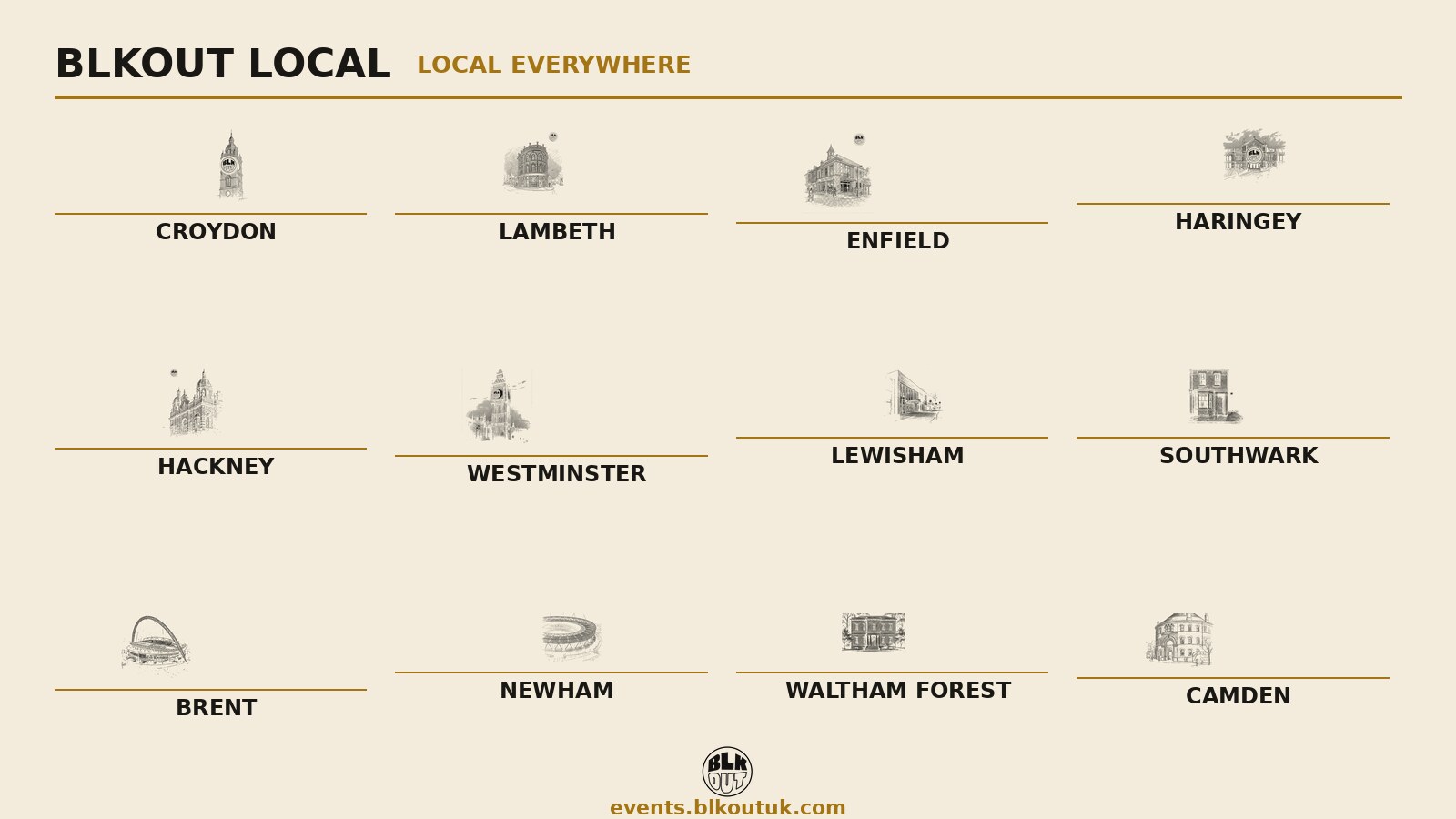
Find yours at events.blkoutuk.com. The fourteen open now: Brent, Camden, Croydon, Enfield, Hackney, Haringey, Islington, Lambeth, Lewisham, Newham, Southwark, Tower Hamlets, Waltham Forest and Westminster. If something's wrong on it, tell us — that's not a criticism, it's the design working. And if you'd open the room for your own borough's evening this autumn, say so. Six years ago I warned what place-based systems do to us when other people design them. It took this many attempts, and this structure, to learn what ours needed: not another project with an end date, but a programme with none.