
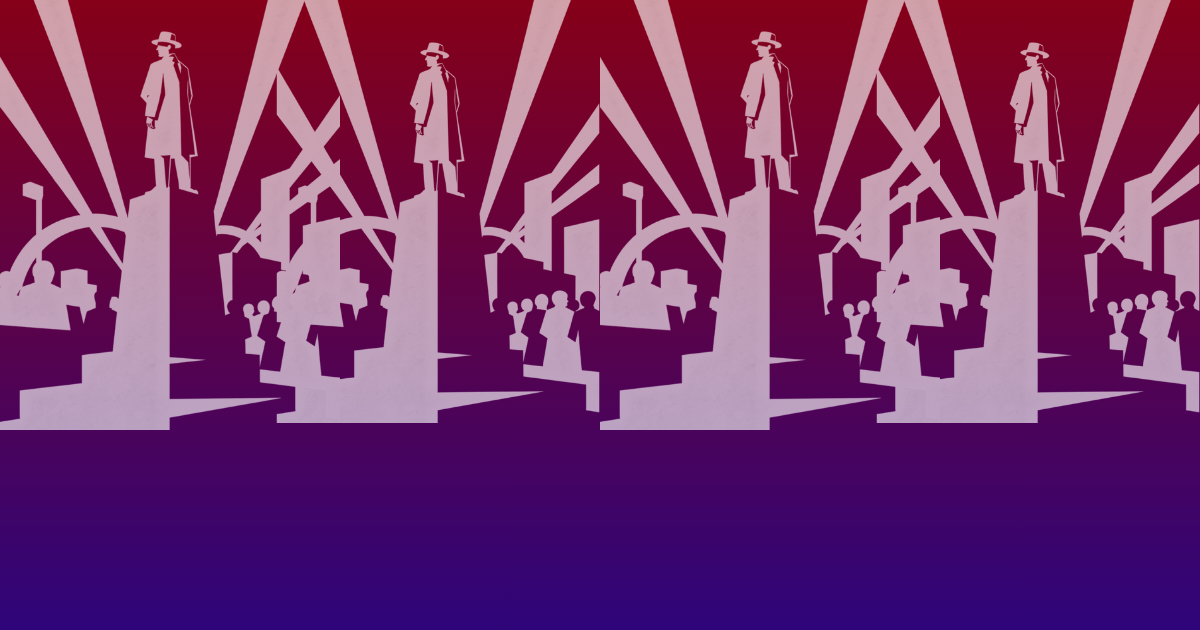
Descend the stairs of a nondescript brownstone. Push past the heavy velvet curtains. The air is thick with cigarette smoke, bootleg gin, and the flickering glow of artificial light off basement walls.
This is not where the Harlem Renaissance was supposed to happen.
The revolution of the 1920s was being documented in glossy magazines and prestigious literary anthologies. The public celebrated the "New Negro" in formal ballrooms. But a more radical, visual pulse was beating in the dark. In the illicit speakeasies and shebeens of Harlem, two artists — Aaron Douglas, the disciplined mentor, and Richard Bruce Nugent, the gay rebel — quietly painted a version of Black identity far more complex than anything seen in the daylight.
Their partnership was often fraught with the tension of the era's respectability politics. But their collaboration bridged the gap between heroic iconography and transgressive bohemianism. Guided by their shared mentor Winold Reiss — who urged them to reject Western academic traditions in favour of their ancestral African legacy — Douglas and Nugent created the visual vernacular of an era.
Here's what surprised me most about their story. And why it matters for what we're doing this Sunday.
The murals that changed under light
The most technologically innovative work Douglas and Nugent produced wasn't on canvas. It was on the plaster of basement cabarets. Influenced by Reiss's focus on geometric abstraction, they developed a mural technique using a two-colour palette of red and blue pigments. This was more than decorative. It was a physical manifestation of W.E.B. Du Bois's theory of double consciousness.
The murals were designed to transform under shifting artificial lights. When the venue was bathed in blue light, the African past — tribal motifs, ancient landscapes, ancestral figures — became the primary focus. As the lighting shifted to red, these Africanist elements would recede, and the modern city — skyscrapers, jazz bands, the urbanites of contemporary Harlem — would emerge.
By forcing the African past and the modern city to coexist on the same surface, Douglas and Nugent allowed the New Negro to inhabit both a rich heritage and a vibrant American reality simultaneously. The identity didn't change. The light did.
That technique is what we've built into the installation opening at Stanley Arts this Sunday. Seven panels depicting chapters of Ivor Cummings's life, lit by coloured gels. Walk through the space and the story shifts. Not because the panels change — because your perspective does. Viewed in a different light. That's not a tagline. It's a method.
The shebeen as radical space
While elite leaders like Du Bois and Alain Locke pushed a racial uplift mandate — art designed to prove Black excellence through moral and professional rigour — Douglas and Nugent sought the liminal freedom of the shebeen. Borrowing a term from the Sophiatown Renaissance in South Africa, these illicit drinking spaces functioned as cultural sponges. They soaked up the raw energy of artists, musicians, and intellectuals who were unwelcome in more formal institutions.
In these subterranean spaces, the artists escaped the watchful eyes of the Black establishment. Away from the pressure to be heroic, they explored themes of urban grit and desire. The irony of the Harlem Renaissance is that its most authentic cultural revival often happened in places of hedonism rather than in the neighbourhood's prestigious salons. In the shebeen, the New Negro wasn't a polished ideal. They were a living, breathing, transgressive human being.
This resonates. BLKOUT exists because the formal spaces — the funded institutions, the heritage sector, the established LGBTQ+ organisations — have not consistently held space for Black queer men. The places where community actually happens are often informal. Club nights. Group chats. Someone's living room. The shebeen principle still applies.
Professional friction and the Sahdji trauma
The collaboration between the disciplined professional and the undisciplined amateur was not without deep scars. A pivotal moment came during the creation of Sahdji. The project began because Alain Locke saw a wash drawing by Nugent and suggested it contained a narrative — prompting Nugent to write the text.
But in a move that Nugent later described as traumatic, Locke decided that Nugent's accompanying art was not up to professional standards. He stripped the visual credit from Nugent and commissioned Douglas to provide the illustrations instead. The resulting work was a masterpiece of Douglas's geometric Africanism. It devastated Nugent. He reportedly did not draw again for an entire year.
This matters because it exposes the rigid hierarchy of the movement. The establishment's obsession with heroic aesthetics stifled the very experimentalism it claimed to foster. Respectable enough for the anthology. Not respectable enough for the art. That pattern — who gets to tell the story, in what form, to whose standards — hasn't gone away.
Niggerati Manor
The creative engine for these artists was their shared life at 267 West 136th Street. A brownstone famously dubbed Niggerati Manor by Wallace Thurman. This domestic sanctuary was a hotbed of creative activity where the lines between high art and hedonism were permanently blurred.
A fascinating stylistic synthesis occurred. Douglas, the former schoolteacher, was characterised by his regular arcs and straight lines. Nugent, the eccentric young vagabond, was obsessed with fluid S-curves and sensuous, erotic line drawings. Their proximity allowed these opposing geometries to merge. Nugent's raw, unmediated energy pushed Douglas toward more experimental, sensuous forms.
The social dynamic was so potent it was satirised in Wallace Thurman's roman a clef novel Infants of the Spring — where Nugent was immortalised as the daring Paul Arbian and Douglas as the serious, race-conscious Howard.
Fire!! and the first overtly gay Black narrative
In 1926, the duo reached their collaborative zenith with Fire!! — a journal intended to be a cooperative venture free from the restraints of white patrons and conservative Black leaders. A bold manifesto of their shared aesthetic and political vision, blending Douglas's structural modernism with Nugent's radical openness.
Douglas, as art editor, designed the front cover featuring a geometric silhouette that signalled a modern African identity. Nugent, as associate editor and writing under the name Richard Bruce, published "Smoke, Lilies, and Jade" — the first overtly homosexual work by an African American.
The juxtaposition of Douglas's geometric Africanism and Nugent's queer, stream-of-consciousness narrative created a visual and literary identity that was as socially provocative as it was aesthetically innovative. A literal fire eventually destroyed much of the stock. But the journal remains the epitome of their symbiotic legacy.
Why this matters now
The relationship between Douglas and Nugent was a vital symbiosis. Douglas provided the structural framework for a new racial iconography. Nugent provided the individual, queer soul that filled those structures with life.
Nugent's longevity eventually made him the ultimate source for the movement's history. In his later years, he co-founded the Harlem Cultural Council and preserved these underground narratives for future generations through documentaries and film. Together, they proved that the New Negro was not a monolith — but a complex figure rooted in both ancient history and the modern, subterranean realities of the city.
Ivor Cummings lived through the tail end of this era. He moved through the same world — jazz clubs, Pan-African politics, the particular pressure of being queer and Black and visible in spaces that wanted you to be one thing at a time. The installation at Stanley Arts this Sunday draws directly on the Douglas-Nugent technique. Panels under coloured light. A story that shifts depending on where you stand.
If the most radical and enduring ideas of the Harlem Renaissance were born in its secret basements, it's worth asking: what underground movements are we overlooking now?
Ivor's Compass launches this Sunday 12 April at Stanley Arts, South Norwood. Free. Book here.
Funded by the Samuel Coleridge-Taylor 150 Small Heritage Grant (Croydon Council / National Lottery Heritage Fund).