
"What is it that we pass along to them or do they, too, need to start from scratch?"
> — Joseph Beam, "Making Ourselves from Scratch", in Brother to Brother (1991), p. 336
Beam asked it for the young men coming after him. He did not live to see the answer. Four scenes from the conversations in this essay suggest what that answer looks like from here.
The first is a book. Marc Thompson remembers the London of the late 1980s, when Black gay men here "looked to the US for everything". Then: "I don't think we would have started Let's Rap and Big Up without In the Life by Joseph Beam" (Ep. 74, 27:36). Beam's anthology crossed the Atlantic, and two of London's first rooms for Black gay men were built in response. What London built from Beam was not a copy. Brent Hayes Edwards calls the difference décalage: "that which cannot be transferred or exchanged, the received biases that refuse to pass over when one crosses the water".
The second is a search engine. Lennox Benson, young, Nigerian and lonely in London: "I remember one day I was googling gay Nigerians in London and I discovered one person called Jide Macaulay" (Ep. 12, 28:38). The priest he found "took me on as his apprentice; he was my mentor" (Ep. 12, 28:55).
The third is a man on the proverbial Clapham omnibus. Wayne Mertins-Brown, a psychotherapist, dresses intentionally, so that nobody can miss him: "And it's not only youngsters, I want to do that for the grown men, the grandfathers, who don't know that it's possible to be an out black queer man. I want them to see me" (Ep. 138, 4:09).
The fourth is an institution. Harvey Kennedy-Pitt started Black Beetle Health, a public health charity for LGBTQ+ people of colour: "It was just supposed to be an Instagram page" (ReportOUT, 21:20). In an episode published in October 2025, Harvey said it was "still running today but under a new CEO" (ReportOUT, 22:12). It has filed no accounts since the year to October 2023, and its website has since gone offline.
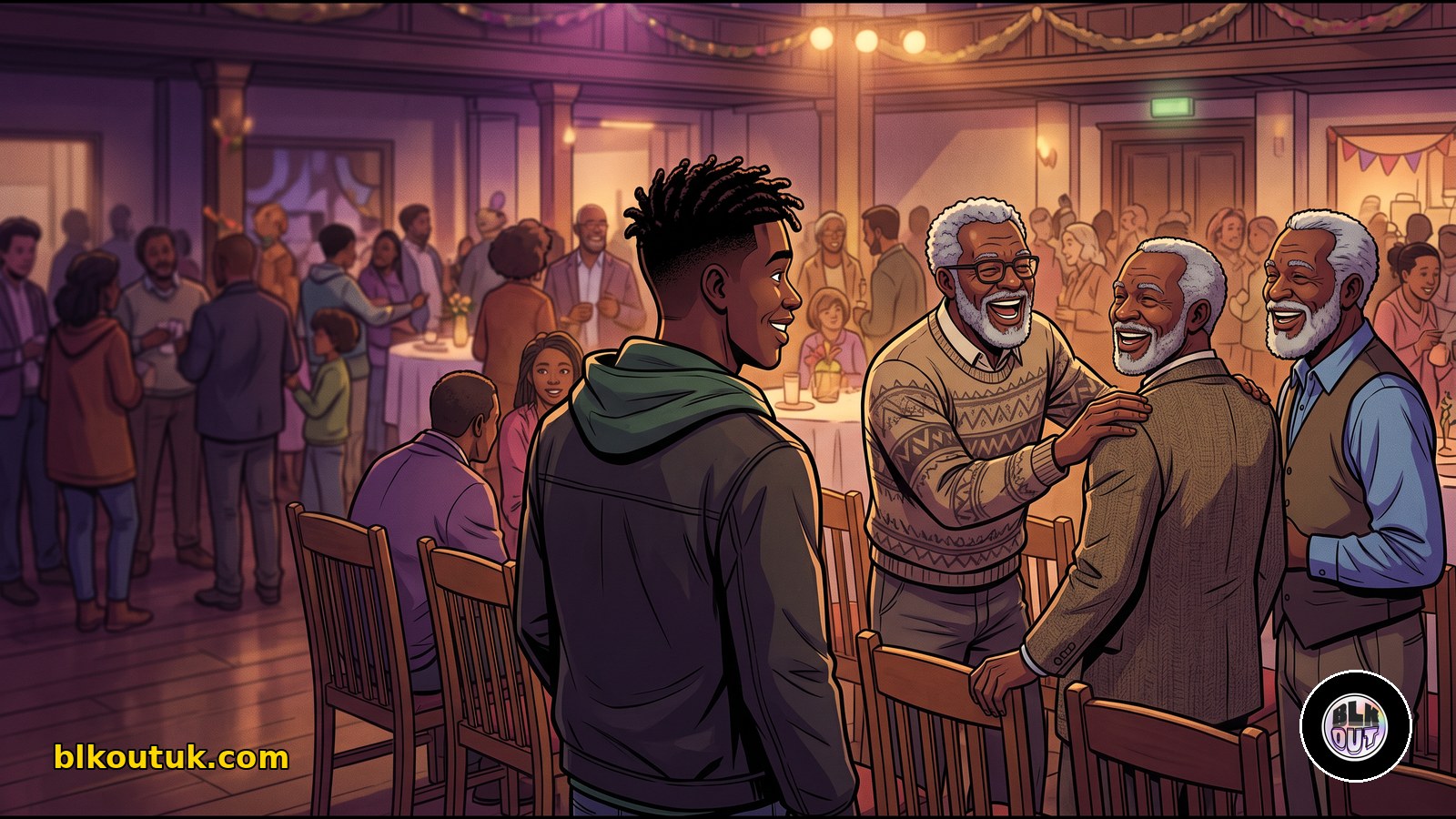
A book, a mentor, a man being seen, a room built intended to outlast its founder. And the case, which Dennis Carney reports from an event he ran, where a young man stood up at the end: "this is the first time in my gay life where I have seen black queer men with grey hair. I didn't know until this evening that you all existed" (Ep. 76, 16:34). Then: "now I know that I have a future … I could be just as fabulous as all of you are" (Ep. 76, 16:49).
He had very nearly started from scratch.
Where I stand
I should say at the outset where I stand, because my sociological training demands it, and Stuart Hall would, I believe, insist on it. I am one of the voices in what follows. Erick Taylor Woodby interviewed me for episode 65 of Our Black Gay Diaspora in the summer of 2023, and I am quoted here, with a timestamp, like everybody else. Twenty years earlier as a volunteer for BigUp@GMFA I was on the other side of a different study: I helped recruit the Black gay men whose lives filled Sigma Research's NHS-funded 2004 report, Ethnic minority gay men. I have been the researched, the recruiter and now the reader.
There is a fourth position, and Beam's question makes me declare it. I named BLKOUT. Briefly, I believed I had had an original thought. I soon realised that the name had history: Black/Out, the magazine of the US National Coalition of Black Lesbians and Gays, whose first editor, in 1985, was Joseph Beam; and Blackout, the magazine London's Black Lesbian and Gay Centre published from 1986. The name was part of an inheritance. I am one of the people it was passed to. Weigh what follows with that in mind.
The lens
The question I bring to it is Hall's, the towering intellect of post-war sociology and cultural studies – and I am not the first to bring him into these rooms. Topher Campbell remembers "a well-known sociologist called Professor Stuart Hall, who I had the privilege of meeting in … my first film, who talks about radical homelessness and about making difference work" (Ep. 95, 17:53). Shaun Wallace names "a very key scholar who influenced a lot of people of my generation of the 90s, and that's Stuart Hall, Professor Stuart Hall" (Ep. 3, 6:25). The lens was in the room before I read with it.
For Hall, identity is not an essence waiting to be mirrored. "Not an essence but a positioning," he wrote in 1990: "Hence, there is always a politics of identity, a politics of position". And cultural politics works through articulation, a word he loved for its double sense. To articulate is to speak. It is also to join, the way a lorry's cab articulates with its trailer: "the form of the connection that can make a unity of two different elements, under certain conditions," a linkage "which is not necessary, determined, absolute, and essential for all time".
Hall did not arrive at identity as positioning alone, and the ancestry matters to this essay. Thirteen years before "Cultural Identity and Diaspora", the Combahee River Collective had written that "the most profound and potentially most radical politics come directly out of our own identity". At Birmingham's Centre for Contemporary Cultural Studies, where Hall worked, Hazel Carby's "White Woman Listen!" (in The Empire Strikes Back, 1982) had already told British feminism and British cultural studies what Black women's positioning did to their categories. Hall's own "New Ethnicities" (1988) followed, declaring the end of the innocent, essential Black subject.
Barbara Christian argued in "The Race for Theory" (1987) that people of colour have always theorised in narrative, in stories and riddles and proverbs. Gramsci would have called the guests organic intellectuals: thinkers who come out of a community and help it say what it wants. These guests are theorists. I read them as such.
So I ask two things of these conversations, section by section. How do the guests challenge the existing order, or stabilise pieces of it for themselves and for us? And how do they position themselves: towards a society that has often excluded them, and towards the belonging they build? I read for disruption, defiance and the demonstration of difference. And I read them, as Hall taught, at this moment. The essay comes in two parts. This first part, sections 1 to 5, asks how the guests stand. Part two, sections 6 to 9, asks Beam's question: what they pass along.
About this study
>
> The material is twenty-eight episodes of Our Black Gay Diaspora, about twenty hours of audio. Erick, who hosts from wherever he happens to be living, compiled every UK guest from five years of his show: twenty-five of us across 2021 to 2026. Gamal Turawa (The Black Cop) is the guest twice, and twice a British guest (Gamal, then Martin Patrick) turns the microphone on Erick. These conversations were recorded to make a podcast, meant to entertain and inform, not as research data.
>
> They were transcribed by machine and read twice: first against a framework, which the text outgrew; then openly, to hear what people said in their own terms. Every quotation has been checked against its transcript and carries its episode and minute. Where the machine misheard, the quotation follows what was said; quotations are lightly edited for readability, and "…" marks an omission. The ReportOUT episode (Harvey Kennedy-Pitt) is cited by name. The healing-first reading is the guests' own method before it is mine: Adé speaks "from my scars and not my wounds", and Gamal prizes conversations with "no self-pity".
>
> This is not the first study of Black gay men in Britain. Sigma talked to twenty Black Caribbean gay men in London in 2003; Jason Okundaye's Revolutionary Acts gathered the elders of Brixton in 2024. What we have here is different in kind: the largest set of long-form conversations with Black queer leaders in Britain that I know of, recorded not by a funder with a question about risk but by a Black gay host with an open microphone and an inquiring mind.
>
> Three limits. The guests are exceptional by design and cannot stand for Black queer Britain. The comparison with Sigma is one comparison, across a class difference. And weathering, in section 4, names what the guests describe; it is not a measurement of them. The status of the organisations named is as of September 2026, from public records (the Charity Commission register, the organisations' own sites, the Bishopsgate Institute's BLGC collection) and my own knowledge.
Part one: how they stand
1. Handing back the word
The first thing these guests do in almost any room is refuse the name it has for them. Erick offers a word, and the guest hands it back.
At least ten do it to his face, and more refuse the show's vocabulary without being offered it. Jay Jay Revlon, called an activist: "I never call myself an activist. I just am active" (Ep. 39, 30:56). His activism, he says, is existing, in a crop top and high shorts in Barcelona. Ajamu X, offered the language of the movement: "That's not my work. My work is to present another way of thinking or being" (Ep. 83, 43:09). Topher, offered authenticity: "So when you say authenticity, I don't know it" (Ep. 95, 23:25). Cyril Nri, BAFTA-nominated for Cucumber, has one answer to every label people reach for, "actor": "So don't put me in a box" (Ep. 48, 24:57).
Martin Patrick, nearly seventy and a veteran of the Gay Liberation Front, doesn't wait to be offered the word most of us under fifty use without thinking. He refuses it anyway: "That is not a word that I take for myself. I am proudly saying and I will always proudly say I am a black gay man, but I cannot proudly say I'm queer" (Ep. 122, 28:23). Asked where he sits on intersectionality, Gamal won't be carved up: "I don't separate myself. I am just one person" (Ep. 23, 4:10).
There is a counter-case, and it matters. Lennox takes Erick's phrase and makes it his own: "Taking the power back, owning my story" (Ep. 12, 30:15). Handing back the word is a choice, not a reflex.
It would be easy to hear this as pedantry, or as the friction of a transatlantic conversation. I hear it as Hall's articulation happening in real time, one sentence at a time. A positioning is not a place you arrive at. It is something you do, against a word someone else has picked for you.
Black feminist thought got here first. Patricia Hill Collins calls it self-definition: refusing the images others hold of you and naming yourself. And José Esteban Muñoz's disidentification, working on and against a dominant code rather than simply rejecting it, is a better name for these exchanges than friction.
Martin's refusal has its own history. It is the word that was used against him, "because of all the dreadful things I was called and when I was gay-bashed" (Ep. 122, 28:08), and it is not the language of the Gay Liberation Front, where he came to himself in the 1970s. Even the refusal is inherited.
And it reads, on the tape, as trust. People only correct you when they expect to be heard. Gamal, turning the microphone on Erick, names the frame's own limit with affection: "You don't interview victims. You interview people who are achievers" (Ep. 59, 39:25).
2. Staying in the room
When disruption comes, it usually comes from inside the room.
Dennis's own first room was a public discussion on homosexuality and the Black community, some time before 1990, at the Brixton Recreation Centre. He paid his twenty pence at the door and panicked: "Do I run or do I stay?" (Ep. 76, 28:09). Then: "I'm not going nowhere. I gave them my 20p" (28:13). Looking back: "if I'd have ran, I'd have probably still be running now in a lot of ways" (28:19). Two weeks later he was treasurer of the Black Lesbian and Gay Centre.
Gamal Turawa, in a room of "about 50 odd people" he had known all his life, gathered for prayers after his father's death, some of whom had helped his father beat him as a child, is asked why he has no children: "And my mouth just says, actually I'm gay" (Ep. 23, 15:04). Lloyd Young, an independent sexual violence advocate, whose role is supposed to stop at the courtroom door: "I advocated with the judge that I can sit beside the victim while the victim given evidence" (Ep. 127, 8:32). He adds, simply, "this was unheard of" (8:46).
Jay Jay, himself a member of Soho House, explains why: "My thing is that I wanna be in those spaces to disrupt, to tell the truth" (Ep. 39, 24:27). Asked to throw a party at its Barcelona house, he sets his own terms: "I will, but this is my terms. You are giving me a guest list. I want people from the streets" (Ep. 39, 24:56). At its Brighton house he wants a mic on his DJ day: "This is not your space. You are on my frequency. I'm not a background DJ" (Ep. 39, 25:30). Marc and the campaigners who took on the health service over PrEP: "So there was a long battle. We went to call the NHS and we won" (Ep. 74, 9:34).
Sometimes the room changes back. Adé Adeniji, one of very few gay men on a weekend of men's work, told the straight Black men there what it cost him: "it was so healing to be able to vocalize that dilemma to straight men and then go, oh, we accept you, we love you, we care for you" (Ep. 49, 29:27). And Lloyd, raised to believe that accepting his identity "as a queer black man, meant leaving the community that I belong to", made a choice: "And that was a struggle for me. And I chose not to" (Ep. 127, 18:05).
This is what Gramsci, and Hall after him, called a war of position: a long occupation of the ground rather than a charge across it. bell hooks would push back. For hooks the margin is not only where you are pushed; it is a place you can choose, "a space of radical openness". The guests answer her through their actions. They stay in some rooms. They leave others.
3. Leaving to breathe
The same people who stay in the room also leave. They tell the leaving not as defeat but as repair.
Ajamu, from a small Yorkshire town: "We have to run and leave those small towns in order to breathe and to create and to reimagine all the kind of ways of being" (Ep. 83, 4:04). Wayne, after trying to live the way he was told to: "actually these are not my people. This is not my tribe" (Ep. 138, 2:21). Of his old job: "I ended up working in a place full of homophobes and racists. This is not where I want to be" (Ep. 138, 3:27). Jay Jay now lives in Barcelona: "But I can't live in the UK" (Ep. 39, 11:06). Steve, who plans journeys for other people, on one he took for himself: "I needed a reset. I needed to slow down and unwind and I wanted thinking space" (Ep. 118, 27:08). Vernal Scott went to "too many funerals for me to believe that there is an intervening God" (Ep. 107, 30:37) in the AIDS years: "Since then, I'm a passionate atheist" (Ep. 107, 4:28).
Some leaving is not chosen. Jide Macaulay, a priest from Lagos who built a church community for LGBT people in Nigeria, was driven out when his "community was under threat of violence. I was forced to return to the UK" (Ep. 68, 9:14).
Pierre Monnerville, a photographer born in Paris to a family from Martinique, came furthest to say it plainly. His grandmother's generation, he says, "wasted most of their energy trying to be whiter than the whites" (Ep. 5, 13:05). At school: "I was taught that my ancestors were white people" (Ep. 5, 13:44). He chose Brighton ("There's the sea, it's very healing", Ep. 5, 31:01) and, in therapy, understood why he had gone so far: "It's no coincidence that I've quote-unquote exiled myself far away from my roots, far away from my family. I'm the only one living in the UK" (Ep. 5, 39:27). What he took from it: "it's never too late to find yourself or to stop and just say, here I am" (Ep. 5, 39:50).
Martinique is Édouard Glissant's island, and Glissant is the theorist of this. His errantry is wandering that is not rootlessness, and his Relation is identity made in movement, between places, rather than inherited from one. The guests live it. Eric Yassine, French and resident in the UK: "so it's always in between but then again I like to be in between" (Ep. 96, 3:08). Nzube Ufodike: "The UK is home, but Nigeria is also home" (Ep. 101, 8:07). Cyril rewrites Langston Hughes: "I too am Nigeria, I too am Barbados, I too am London" (Ep. 48, 7:30). Keith Jarrett, with a Londoner's geography: "Scotland is further for me than France" (Ep. 126, 42:43).
So the claim is not that nobody walks out. The political act is told in the room; the exit is told as healing; and most guests do both.
4. Holding the line, and what it costs
If disruption is an act, defiance is a stance held over years. It has a price, and the guests are frank about who pays it.
Lloyd reported abuse to the police. They asked him where the victim was. He was standing in front of them: "You're a big strapping black man. You could look after yourself" (Ep. 127, 13:35). "I felt humiliated and ashamed" (13:38). Gamal: "I had to unlearn the fact that if I talk, I have to soften my voice because I don't want people to think I'm being an aggressive black man" (Ep. 40, 40:53). I said something similar about myself, including the gendered stereotype I was steering round: "I was policing other people's racism in space without ever shouting because I don't want to be perceived as a crazy black woman. That view is gendered in that way" (Ep. 65, 23:05).
Audre Lorde taught that anger carries information: a resource, not a disorder to be managed. Collins named the controlling images (the angry Black man, the "crazy" Black woman) that make that resource so costly to spend. What these men describe is the engineering required to be heard without being seen as the image. My own reach for a Black woman's stereotype to describe my self-policing is what Moya Bailey calls misogynoir, "anti-Black racist misogyny". Black men, I think, learn to fear being mistaken for its target.
Some of the engineering is institutional. Gamal joined the Metropolitan Police, stating plainly a conclusion reached through years of soul-searching: "And part of my reason for joining the police was, I wanted to be white" (Ep. 23, 22:53). The uniform "became my shield, became my protection to stop me from being me" (Ep. 23, 34:01). Some of it is the strategy of disclosure that Sigma found twenty years ago, still in use. Nzube: "when it comes to disclosure it's about being strategic" (Ep. 101, 33:44). Shaun, in Nigeria, found "it was like going back in the closet for me" (Ep. 3, 10:43), and says he rather liked it.
And some of it I carried home on the night bus. "I have this real memory of my 20s where I would be openly gay in Zone 1 of London and by the time I got to Outer London where my parents lived I wouldn't. On that bus ride somehow I'd fold myself up into somebody who could pass. I'm still healing from the damage I would do to myself on those bus rides" (Ep. 65, 18:30).
There is a name for that damage. Arline Geronimus calls it weathering: the wear that the stress of ordinary life in an unjust society does to the body, early. Sherman James called the high-effort coping behind it John Henryism. Geronimus's evidence is American and mostly about Black women. James built John Henryism from studies of Black men, which is why it fits these guests so closely. I use both terms for what the guests describe, not as a measurement of them. But it answers a saying we like to tell ourselves. Black don't crack. The skin may not. The body keeps the account. Shaun puts it without theory: "the stresses that black people have to face, whether they're LGBTQ or not" (Ep. 3, 34:39). A few are candid about how close it came. Gamal: "I almost committed suicide. I didn't, in case you're wondering" (Ep. 23, 11:06). Nzube: "I literally wouldn't be around today if not for my logical family" (Ep. 101, 37:40).
This is where healing lives in these conversations: not in a separate section of hope, but in the same breath as the bill. Shaun on counselling: "that changed my life, changed my life entirely" (Ep. 3, 35:31). Wayne: "So I did have to go and seek a black therapist after having a white one for many years" (Ep. 138, 23:30). Adé on how he speaks about his own past: "sharing from my scars and not my wounds" (Ep. 49, 44:29). Gamal on what he values in talking to Erick: "there is no self-pity in our conversations" (Ep. 40, 31:50).
I told Erick I admire the work of Yolo Akili, whose Black Emotional and Mental Health Collective has made this kind of repair an institution in the US. It belongs to a lineage Black feminist organisers named healing justice in the mid-2000s: repair as collective and political, not private.
Lorde, writing with cancer, had the phrase for all of it: caring for herself was "self-preservation, and that is an act of political warfare". Self-preservation, not wellness. The guests mean the same thing.
5. Being seen so the next one can be
Every demonstration of difference in these conversations has an audience, and the audience is very often another Black queer person, or themselves at another age.
Wayne keeps a mirror by his front door: "is there any doubt that you could be a gay man? If there is the slightest doubt, I'll go and find something to put on" (Ep. 138, 3:38). The nails are painted rainbow, for the grandfathers. Jay Jay puts the same argument through a wig and a beard: "If a child sees me in the street, okay, and they see my nails, which they have, multitudes of times. And they look at it and they go, 'Oh my God, look, that man has nails!' somewhere down the line, they're going to think that having nails as male-presenting or otherwise is okay if they see me in a wig with a beard" (Ep. 39, 35:16).
The writers make the thing they needed. Lennox wrote a children's book about a Black family of two fathers and their son because "if I'd seen it as a child it would have been like a beacon of hope to see myself reflected and to see what I could possibly have in the future" (Ep. 12, 5:32). Dean's readers are not only young: his novel, he says, is "healing some inner children as well as some actual children right now" (Ep. 109, 2:48).
And the demonstration runs up the age range as well as down it. Cyril: "As we get older, we need to see those images too" (Ep. 48, 18:04). Martin: "I'm crowding 70 come next year. And I feel marvellous" (Ep. 122, 39:37). Yassine Senghor, the one queer woman among the guests, runs a project for "the elders to not only pass on their histories, but then also to create these intergenerational links and connections as well" (Ep. 11, 48:19). Grey hair, in these conversations, is not decline. It is evidence.
Being seen is also a pleasure. Yassine describes their own arrival: "And it was like a literal bursting into technicolor when I kind of was like, look, I'm just gonna be as queer as I can be because actually this is quite fun and entertaining" (Ep. 11, 30:12). Fun. It is the word the deficit literature never uses.
Not everyone owes it. Topher: "I don't represent anything other than myself" (Ep. 95, 6:53). Leon Lopez, the show's first guest, an actor and television director who came up through the soap opera Brookside, never made an announcement; he went public when the work needed it: "one of the first times was only when I started making films because the stories that I wanted to tell were kind of based on my life" (Ep. 1, 23:42).
Two traditions meet here. One is the Black gay art of being seen that Marlon Riggs's Tongues Untied and Isaac Julien's Looking for Langston made in 1989. Wayne chooses the grandfathers; Leon chooses the films. The other is quieter. Darlene Clark Hine described a culture of dissemblance among Black women, a reticence that protected an inner life from a public that would misuse it. Topher's refusal to represent anyone belongs to that tradition.
Part two, "What they pass along", follows on Tuesday 10 November.
---
Sources and further reading
The conversations. Erick Taylor Woodby (host), Our Black Gay Diaspora, UK episodes 2021–2026: Eps. 1, 3, 5, 11, 12, 23, 39, 40, 48, 49, 59, 65, 68, 74, 76, 83, 95, 96, 101, 107, 109, 118, 122, 125, 126, 127, 138 and ReportOUT.
Cited in the text.
- Joseph Beam, "Making Ourselves from Scratch", in Essex Hemphill (ed.), Brother to Brother: New Writings by Black Gay Men (1991; RedBone Press reissue, 2007), p. 336; Joseph Beam (ed.), In the Life: A Black Gay Anthology (1986).
- Stuart Hall, "The Great Moving Right Show" (Marxism Today, January 1979, p. 15); "Race, Articulation and Societies Structured in Dominance" (UNESCO, 1980); "On Postmodernism and Articulation" (1986; in Essential Essays vol. 1, 2019, p. 235); "New Ethnicities" (1988); "Cultural Identity and Diaspora" (1990; in J. Rutherford ed., Identity: Community, Culture, Difference, pp. 225–226); "Constituting an Archive" (Third Text, 2001).
- P. Keogh, L. Henderson and C. Dodds, Ethnic minority gay men: Redefining community, restoring identity (Sigma Research, 2004).
- Combahee River Collective, "A Black Feminist Statement" (1977).
- Hazel Carby, "White Woman Listen!", in CCCS, The Empire Strikes Back (1982).
- Barbara Christian, "The Race for Theory" (1987).
- Patricia Hill Collins, Black Feminist Thought (1990).
- José Esteban Muñoz, Disidentifications (1999).
- bell hooks, "Choosing the Margin as a Space of Radical Openness" and "Homeplace: A Site of Resistance", in Yearning (1990).
- Brent Hayes Edwards, "The Uses of Diaspora" (Social Text 19(1), 2001); The Practice of Diaspora (2003).
- Édouard Glissant, Poetics of Relation (1990; trans. 1997).
- Audre Lorde, "Uses of the Erotic" (1978), "The Master's Tools Will Never Dismantle the Master's House" (1979), "The Uses of Anger" (1981), in Sister Outsider (1984); A Burst of Light (1988).
- Moya Bailey, Misogynoir Transformed (2021).
- Arline T. Geronimus, "The weathering hypothesis and the health of African-American women and infants" (Ethnicity & Disease, 1992); Weathering (2023).
- Sherman A. James, S. A. Hartnett and W. D. Kalsbeek, "John Henryism and blood pressure differences among black men" (Journal of Behavioral Medicine, 1983); Sherman A. James, "John Henryism and the health of African-Americans" (Culture, Medicine and Psychiatry, 1994).
- Marlon Riggs, Tongues Untied (1989).
- Isaac Julien, Looking for Langston (1989).
- Darlene Clark Hine, "Rape and the Inner Lives of Black Women in the Middle West" (Signs, 1989).
- Jessica Gordon Nembhard, Collective Courage (2014).
- Valerie Mason-John and Ann Khambatta, Lesbians Talk: Making Black Waves (1993).
- Kobena Mercer, Welcome to the Jungle (1994).
- Jafari S. Allen, There's a Disco Ball Between Us (2021).
- Saidiya Hartman, "Venus in Two Acts" (Small Axe, 2008).
- Christina Sharpe, In the Wake: On Blackness and Being (2016).
- Jason Okundaye, Revolutionary Acts (2024).
Worth reading alongside.
- Avtar Brah, Cartographies of Diaspora (1996).
- Beverley Bryan, Stella Dadzie and Suzanne Scafe, The Heart of the Race (1985).
- Katherine McKittrick, Demonic Grounds (2006).
- Paul Gilroy, The Black Atlantic (1993).
- E. Patrick Johnson, "'Quare' Studies" (2001).
- Cathy Cohen, "Punks, Bulldaggers, and Welfare Queens" (1997).
- Kimberlé Crenshaw, "Demarginalizing the Intersection of Race and Sex" (1989) and "Mapping the Margins" (1991).
- bell hooks, Black Looks (1992), We Real Cool (2004), The Will to Change (2004).
- Tina Campt, Listening to Images (2017).
- adrienne maree brown, Pleasure Activism (2019).
- Ruth Wilson Gilmore, Golden Gulag (2007).
- Essex Hemphill, Ceremonies (1992).
- Armistead Maupin, Logical Family (2017).
- BLKOUT Collective, "Read: BlackOut Inheritance", parts one to four (blkoutuk.com, 2018): BLKOUT contributors on what they inherited from other Black gay men, and what they would pass on, after seeing Matthew Lopez's The Inheritance at the Young Vic.
On pardna. Sinai Fleary, "Pardna 2.0: how Black Britons are modernising a cherished tradition", The Voice, 30 July 2024.
Archives. Haringey Vanguard (hqbh.co.uk); Bishopsgate Institute, Black Lesbian and Gay Centre collection; GMFA Legacy Archive (gmfa.org.uk).
Theory quotations checked on 29 September 2026 against primary texts where available, otherwise against reliable secondary quotation.