
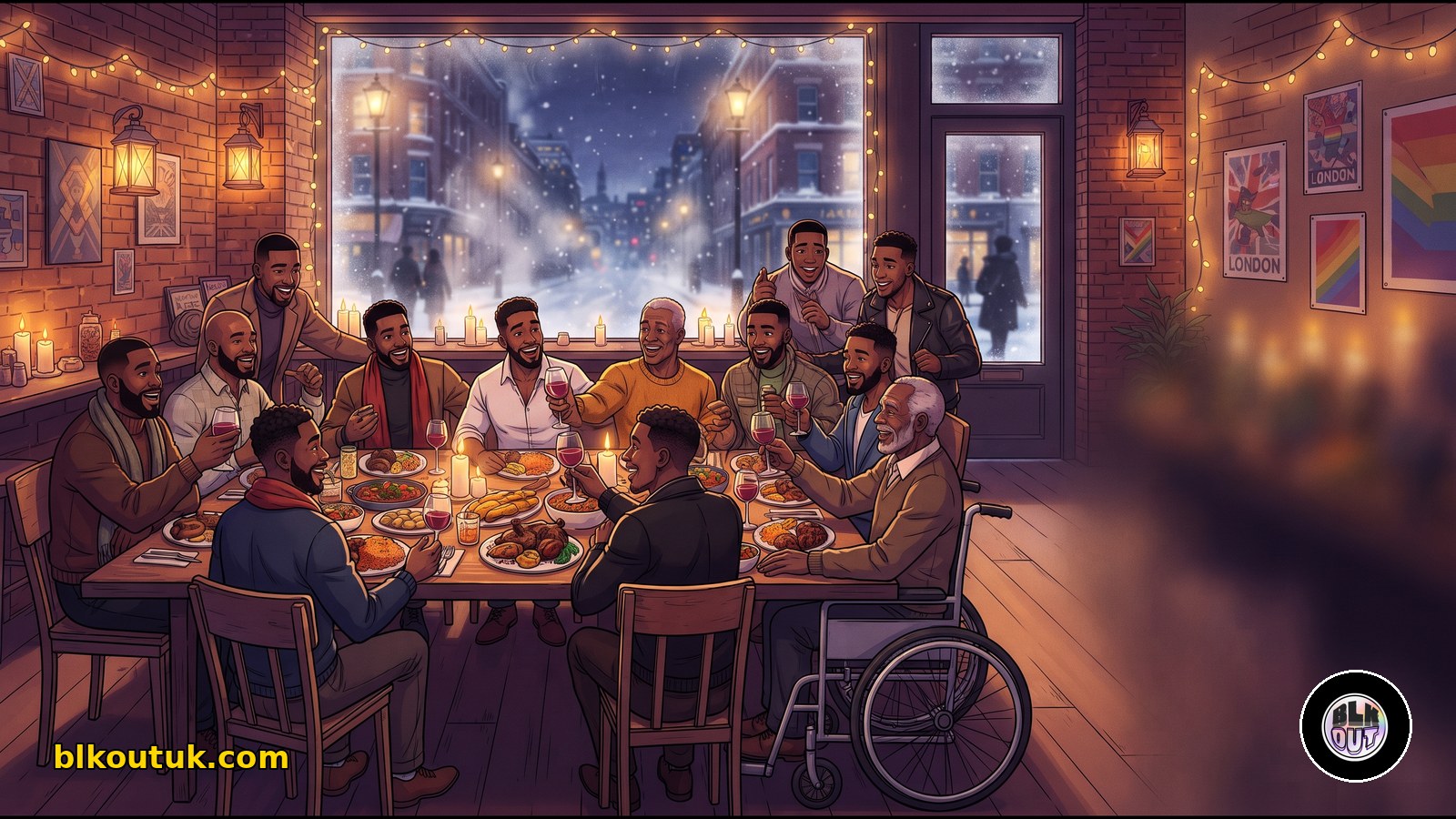
"What is it that we pass along to them or do they, too, need to start from scratch?"
> — Joseph Beam, "Making Ourselves from Scratch", in Brother to Brother (1991), p. 336
Part two: what they pass along
6. Rooms out of errands, and who holds the keys
Hall's order is never simply imposed. It is held in place, and people excluded from it also hold things in place, for themselves and for each other. Most of the rooms in these conversations began as an errand.
Harvey's charity began as an Instagram page for "this group of people here who identifies both when they're being left somewhere in the middle" (ReportOUT, 20:51). Jide: "It was after my HIV diagnosis that I started House of Rainbow" (Ep. 68, 21:57). Topher: "once you find yourself displaced or unhomed or unhoused or out of space in terms of your identities, then what you do, you have to create these spaces" (Ep. 95, 18:24). Ajamu: "My work is still about creating what I need to see" (Ep. 83, 15:10). Lloyd's Black Experience: "I've been around since the 90s. I think I've celebrated 30 years" (Ep. 127, 6:36). Steve's travel company grew from "hearing what people see, what they discover" (Ep. 118, 5:52).
Ownership, in the telling, is mostly singular. Vernal: "Thankfully, I own the copyright" (Ep. 107, 2:39). Martin became an independent author to "keep my intellectual property and work on my own behalf" (Ep. 122, 38:08). Jay Jay: "I want to be paid for the work I do from these corporations and brands and shit" (Ep. 39, 34:10). The vocabulary of ownership is singular even where the rooms are held in common. There is one institutional answer to the plural question, from Marc: "And what is amazing and unique about our company is that the community is the company and the company is the community" (Ep. 74, 12:52).
The plural question itself is asked once, and I asked it. "So I looked around and thought, well, what do we own together? What could we say is the legacy of, in terms of what we're giving to the next generation?" (Ep. 65, 9:32). And, a few minutes later, of the clubs we lost: "And we've never held the keys" (Ep. 65, 12:18).
History has not waited for this essay. Of the rooms named in these conversations, the Black Lesbian and Gay Centre, which found a railway arch in Peckham in 1992, did not survive 2000. Let's Rap and Big Up, carried by GMFA, had gone long before GMFA itself became LGBT HERO; GMFA now survives as a legacy archive of itself. The Quest Collective, which Adé co-founded, has ceased operating. Black Beetle Health has quietly wound down: no accounts filed since the year to October 2023, and its website, once full of health resources, gone. What stands is a congregation (House of Rainbow, twenty years old this year), a company whose community is the company (the Love Tank, home of PrEPster), an archive (rukus!, active when its keepers are), and an idea (Lloyd's Black Experience). The record of BLGC survives because others kept it: Veronica McKenzie's documentary, the Haringey Vanguard project, and the Bishopsgate Institute.
That is Beam's question, answered in two parts. People and records get passed along. Rooms are harder. Of eight rooms named on tape, four have gone and four stand, and eight is too few to say why. But the ones still standing share something. Each is held by a practice rather than by a founder or a grant: a congregation that keeps meeting, a company whose community is the company, an archive its keepers return to, an idea people keep using. They are built into a community's habits rather than standing apart from it as an intervention. That is a question, not a finding. Audre Lorde warned that the master's tools will never dismantle the master's house. A treasurer's post, a copyright, a charity registration: are these the master's tools, or tools rearticulated? The evidence here does not settle it either.
It is also not a new problem, or only ours. Jessica Gordon Nembhard's Collective Courage (2014) is a reminder that holding things in common has a Black lineage, not a borrowed one: two centuries of African American co-operatives, mutual aid societies and credit unions, built by people who could not rely on the market or the state. The Windrush generation brought its own: pardna, or sou-sou, savings held in common that bought houses and paid for weddings when the banks would not. The people now trying to revive it describe a younger generation that may know about pardna but does not really take part; an app and a children's game are the latest attempts to hand it on. bell hooks called the home Black people made for each other a homeplace, a site of resistance. The question these rooms leave is how to make a homeplace that outlives its founders.
7. Who is in the room
Hall adds a warning: societies are "structured in dominance", and so are the communities made inside them. So is the "we" these guests build. Ajamu draws a line inside the tribe: "Not everything that's black and queer is for my black queer ass neither" (Ep. 83, 45:12). Pierre built his t-shirt brand, Unapologaytic, against the shaming Black gay men do to each other (masc-for-masc, fem-shaming, dark skin), because "where you've been oppressed your whole life, your ancestors have been oppressed, and then because that's all you know, if you don't think it's very easy to reproduce that same oppression to your people" (Ep. 5, 24:09).
And the set has its own structure. Twenty-three of the twenty-five UK guests speak as men. One is a queer woman. Shaun speaks of "being non-binary" (Ep. 3, 17:55) and "for me as a black man" (Ep. 3, 21:18) in the same hour. The mixed rooms the guests remember most warmly are historic: the Gay Liberation Front, and a Black Lesbian and Gay Centre that split a £500 grant down the middle, "250 pounds for the women and 250 pounds for the men" (Ep. 76, 40:42). The rooms they run now are often mixed by design (a clinic's staff, a church, a ball, a Pride), but the tapes are predominantly men talking to a man. Martin, turning the microphone on Erick, names the change: "I also see more alienation in the 21st century among the LGBTQ than I experienced during the 20th century, where the connection between lesbian and gay men was so much stronger within my own frame of reference" (Ep. 125, 44:34). The imbalance is part of the finding, not a footnote to it.
Valerie Mason-John and Ann Khambatta's Lesbians Talk: Making Black Waves (1993) is the Black lesbian account of the same London years, and would be the place to begin asking what the BLGC's split grant meant from the other side.
8. Sex, love and the floor
Sex and love are not asides in these conversations. They are part of the politics, and the guests say so.
Dennis names the word he says gets left out whenever others talk about us: "the word that gets missed a lot when black queer men are talked about in any way, is this four letter word, L-O-V-E, love" (Ep. 76, 9:34). And the other thing: "especially as Black queer men that we are sex positive, we talk about the sex that we have positively, because it's talked about so negatively" (Ep. 76, 10:57). Tired of conversations about us that are "very victim, blah blah blah" (Ep. 76, 35:04), he offers his own summary of forty years: "I have had a ton of joy in that time. I've also had a lot of sex" (35:19).
Martin joins desire to dignity: "We talk about queer politics today, but what I'm still not reading about is the love that men have for each other … is to me intrinsically bound with respect" (Ep. 122, 29:28). And of his own youth: "In my 20s I was in love. I had a man. I had a home" (Ep. 122, 25:34). Jay Jay found it in ballroom: "this language is like a language of love" (Ep. 39, 18:51).
Pleasure is argued for, not merely admitted. Dean, on the figures in a stop-motion animation of his work, made for adults: "And so we should be able to show their penises. Like, it's not a big deal" (Ep. 109, 24:59). Keith, questioning respectability: "being accepted and respected, isn't the be all and end all? And sometimes doing the skanky, skanky, scandalous thing" (Ep. 126, 27:54). Pierre found his vocation at fourteen in a Paris bookshop, in front of Mapplethorpe's Black Book: "And I had never been so shocked and turned on at the same time. And I thought, I want to be a photographer" (Ep. 5, 5:38). Kobena Mercer argued with that book twice, first as critique and then as reconsideration. Pierre, a Black gay photographer of men, answered it with his own camera.
Another photographer, Ajamu, insists that the archive keep what it usually drops: "Usually it's your sex spaces, your cruising grounds gets excluded, your sex parties, your bath houses" (Ep. 83, 10:01). "These are spaces that we come together in the context of the sexual" (10:12). His prescription: "More pleasure, more pleasure, more pleasure" (Ep. 83, 45:47).
Lorde, writing of and for women, called the erotic a source of power and knowledge, not a distraction from politics. Beam wrote that "Black men loving Black men is the revolutionary act of the eighties", and Dennis quotes him on tape. These guests are the evidence that he meant it literally.
The one position the conversations cannot settle is the dance floor, and I think it should stay unsettled. Topher: "a kind of a home which was clubbing. I was a club kid quite politically, emotionally, spiritually, sexually" (Ep. 95, 28:04). Pierre, leaving a Paris club at five for the first metro: "I really love this but I'm sure I grow out of it" (Ep. 5, 21:34). He never did. Marc holds both. Of the rooms he found beyond the club: "I found the community connected people in a different way to how I had done in club spaces, less competition, we're not all looking for sex, we're not all looking to hook up. It was very different. It was communal, it was fraternal" (Ep. 74, 25:16). And of the club itself: "we undervalue the importance of the gay club and the dance floor because we find sanctuary, we find love, we find release in those spaces" (Ep. 74, 38:01).
I have argued with myself about it on tape: "of being upstairs in Heaven on a Wednesday night with 200 other black men dancing or to be at Bootylicious, and then people tell me that they weren't connecting with each other. I just couldn't get my head around it" (Ep. 65, 29:38). And, less comfortably: "the way in which we socialize is to avoid intimacy to avoid things that we know are good for us" (Ep. 65, 24:53). Both things are true. Two hundred Black men dancing is both a community and a way of not being one. Jafari Allen has written the book-length theory of that tension. It is the thing a community has to keep working on.
9. This moment: the recruiters became the guests
Hall's other gift was the conjuncture: the insistence that you read a politics from the particular moment in which contradictions come together, rather than from the general laws of history. So what moment are these guests speaking from?
Chronologically, they speak from 2021 to 2026. Leon and Shaun record in the lockdowns of spring 2021. Yassine records in the summer of 2021, a couple of months after the then government's racism-denialist race report. Eric Yassine records the week of the riots in August 2024. Lloyd records in 2024. Vernal, Martin and Keith record in 2025 and early 2026, as a new American administration begins to roll back what we felt was won.
The silences belong to the moment too. Across twenty hours of conversation about Black queer life in Britain, nobody says the word Brexit. Section 28, lived through by all those in Britain before 2003, is named only twice. The prime ministers anyone names belong to history: Churchill in passing, and Thatcher, whom Martin remembers as "a common enemy" (Ep. 122, 4:39). Nobody names one since. Governments do come up (the Tories and gay marriage, a race report, the campaign to ban conversion therapy), but when the state is spoken of in the present tense it is almost always the police, the NHS, the courts and the Church.
The shape of the moment, in their words, is retrieval. The counter-order built between the mid-1980s and the mid-2010s is being archived and staged: in a Tate display, a Channel 5 documentary, a revived play, a book and a podcast. Topher: "And now it exists" (Ep. 95, 25:33). Keith: "the files are there, the archives are there, it's just yet another stamp to say we were here, we are here, we still will be" (Ep. 126, 37:53). Lloyd notices the young coming to look: "but in today's society young people are looking for what was happening 30 years ago" (Ep. 127, 29:16). Keith, being archived, puts it with a smile: "I don't want to be a historical figure yet" (Ep. 126, 36:40).
Retrieval is also Saidiya Hartman's problem turned inside out. Hartman writes of the archive of slavery, which holds a girl like Venus, the enslaved girl at the centre of her essay, only in words "borrowed from the world of her captors and masters". Here the guests are writing their own record, in their own voices, while they are alive to correct it. Hall reminds us that archives are "in part constituted within the lines of force of cultural power and authority".
And the weather is turning. Vernal, watching Washington: "What the White House, the current regime is telling me is that for all the advances that we've made it can be erased in no time with the wrong leader" (Ep. 107, 11:41). Keith, at home: "There was this mass like far right march that happened that I'm still kind of reeling from" (Ep. 126, 39:36). Dean, who went to school under Section 28 ("when I was in school there was a law in place called section 28 which meant you couldn't have LGBT books in school", Ep. 109, 30:12), is blunt about what law does and doesn't secure: "attitudes are slow and can also regress. You know, we've got to keep publishing the books" (Ep. 109, 31:57). Harvey, working in global health, is the most explicit: "you can see over 25% cuts to the organization due to being defunded" (ReportOUT, 16:27); this is a "maybe nightmarish, time to be alive anywhere in the world" (39:24), with "attacks on our trans siblings" (5:53).
"The weather" is Christina Sharpe's word before it is mine, and she uses it precisely: the total climate of antiblackness, which does not turn. Read beside her, my phrase is too hopeful. What turns is not the climate but its intensity, and weathering is what the climate does to a body; the same thing at two scales.
The moment is easier to see against an earlier one. In 2004 Sigma Research published Ethnic minority gay men: Redefining community, restoring identity, an NHS-funded study of twenty Black Caribbean gay men in London. Its acknowledgements thank "BigUp @ GMFA for invaluable assistance with recruitment". Marc Thompson and Dennis Carney had both worked at Big Up, built because, as Marc puts it, "nobody else was responding for us" (Ep. 74, 25:40). By 2003 both had moved on. I was volunteering there, and I recruited for the study. The organisations Black gay men had built were the study's route to its sample; the men in it were anonymised by age and occupation.
Be fair to Sigma, because the fairness is the argument. It was not a deficit report. It refused the language of needs assessment, and it saw what we now call articulation: "no gay man is simply gay". It even named the men 'pioneers': "They are pioneers – creating new ways of being Black and gay". But the settlement it wrote within shows. Sigma was adding a qualitative layer to statistical work that was inherently comparative, and the norm it compared against was white gay men. Its agenda was driven by epidemiology, not healing. When the only money is HIV money and the speakers are researchers, identity becomes information management, and concealment becomes, in the report's own words, "at least, functional". Racism on the scene becomes something "culturally bound and largely subjective". The men's words strain against the categories ("I want to be around my people and this is the only place to go"), but the report has a place for coping and none for wanting.
What changed by 2021 is not that Black queer men became braver, or that our families became kinder. Sigma's men already chose Black friends, avoided the parts of the scene that commodified them, and knew exactly what they were doing, and section 4, in Part one, shows that the strategy of disclosure is still with us. What changed is who holds the frame, and what it is for. An open conversation between Black gay men, on a platform one of them owns, makes things sayable that a risk interview cannot: love, pleasure as a politics, a Black therapist after a white one, being seen by the grandfathers, and ownership. That is the conjuncture, in miniature: a shift from being described as a population to speaking as the keepers of the record. The recruiters became the guests.
The comparison has a limit, and I should name it. Sigma wanted men who could stand for others. Erick's guests are exceptional by definition and by design: founders, artists, clergy, clinicians, people with a public. They cannot stand for Black queer Britain, and this essay does not ask them to. What they show is what becomes sayable when the exceptional set the agenda.
The continuity matters as much as the change. A man in 2004 said "there was no foundation at all for being what I am now". A man in 2023 said "It starts from I want to start an organisation to save my life" (Ep. 65, 5:35). That second man was me, borrowing from Essex Hemphill, who finished the book Beam could not. We were asking Beam's question twenty years apart. The difference is who got to ask it, and who got to keep the answer.
Coda: what we pass along
I set out to ask how twenty-five Black queer people in Britain challenge the order or stabilise it, and how they position themselves between exclusion and belonging. The answer, in Hall's terms, is that they articulate. They speak, and they join. They join what Britain keeps apart: Black and queer, Nigerian and Londoner, priest and gay man, desire and dignity. They cut what Britain insists belongs together: Blackness and heterosexual masculinity, queerness and whiteness, faith and shame. They stay in some rooms and leave others to breathe. And they build rooms, usually by accident, with whatever tools are to hand: a treasurer's post, a copyright, an Instagram page, a WhatsApp group meant for ten.
Beam's question gets a split answer. What we pass along is people and records: a book that crosses an ocean, a priest who answers a stranger's search, a man who paints his nails for a grandfather, an archive kept by others, a name. What we have passed along less well is the room. Some close, and the next generation builds them again. The ones that last are the ones a community keeps using. I ended my own conversation with Erick where I still am: "I'm really keen to do what I can, but I don't know what I can do yet. And I'm still learning. Let's work together" (Ep. 65, 35:38).
This winter we will try one small answer in Croydon. Eight Black queer men will each choose a place in the borough that carries our history, write a monologue of invitation from it, and learn to hold a room with it. On Monday 28 December, between the anniversaries of Beam's death and his birth, a day we are calling Joseph Beam Day, they will host a dinner at Stanley Arts for the people they invited, and publish their recordings. We named the project Making Ourselves From Scratch, after Beam. The point is in the title. Nobody should have to start from scratch alone, and a room you are trusted to host is a room you are more likely to keep.
So this essay is not only an analysis. It is an invitation, and I want to make it by name.
To Ajamu and Topher, who built the archive. To Marc and Dennis, who built the rooms I volunteered in. To Martin, who refused the word and wrote the love. To Gamal, whose mouth decided before he did, and who brought Wayne, Nzube, Vernal and Eric to Erick. To Wayne, and the mirror by the door. To Jay Jay, and the mother on the door. To Keith and Dean, poets who keep publishing the books. To Lloyd, who chose not to leave. To Jide, who through abundance of love will be anybody's family. To Vernal, who owns the copyright. To Cyril, who is Nigeria, Barbados and London at once. To Nzube and Adé, who know what it costs to carry the whole of yourself into a room that only wants half. To Eric, who likes to be in between. To Leon, Erick's first guest, and to Shaun, who asks us to stop thinking in binaries. To Steve, who builds journeys, and Harvey, who builds health. To Lennox, who writes the books a child needs. And to Yassine, who reminds us that the "we" of this essay was never only men.
Erick gathered us, but the tapes show we had been finding each other for years: a priest answering a stranger's search, a dinner leading to an interview, one guest bringing four more. We are more interdependent than any single conversation lets on.
I have learned something from every one of these conversations, and most of it is about what gets handed on: a book, a name, a word handed back, a door held open. I carry it into BLKOUT as a question rather than a plan, how to build rooms a community keeps using, and I am still learning the answer from everybody named here.
Jide has already said it better: "If you can't find them, get in touch with me. I will be your family" (Ep. 68, 43:33). Dean: "we don't need to do it alone" (Ep. 109, 27:03). Vernal, for all his wariness about Washington: "The future because of us will be better than the past" (Ep. 107, 38:34).
We learn. We articulate. Our lives depend on it.
An invitation from BLKOUT
When BLKOUT's membership opens in December, I want every one of you who can to join us. Not because we hold a monopoly on truth, or a repository of answers. We don't. But because we are committed to articulating our positions, as key to our liberation: in dialogue with each other, with us, and above all with the next generation and with our Black lesbian and trans siblings. Come and disrupt with us. Demonstrate difference with us, as family: logical, not biological. Write and record, laugh and cry, shout in affirmation or whisper sage advice, here's the call, I hope you'll respond.
---
Sources and further reading
The conversations. Erick Taylor Woodby (host), Our Black Gay Diaspora, UK episodes 2021–2026: Eps. 1, 3, 5, 11, 12, 23, 39, 40, 48, 49, 59, 65, 68, 74, 76, 83, 95, 96, 101, 107, 109, 118, 122, 125, 126, 127, 138 and ReportOUT.
Cited in the text.
- Joseph Beam, "Making Ourselves from Scratch", in Essex Hemphill (ed.), Brother to Brother: New Writings by Black Gay Men (1991; RedBone Press reissue, 2007), p. 336; Joseph Beam (ed.), In the Life: A Black Gay Anthology (1986).
- Stuart Hall, "The Great Moving Right Show" (Marxism Today, January 1979, p. 15); "Race, Articulation and Societies Structured in Dominance" (UNESCO, 1980); "On Postmodernism and Articulation" (1986; in Essential Essays vol. 1, 2019, p. 235); "New Ethnicities" (1988); "Cultural Identity and Diaspora" (1990; in J. Rutherford ed., Identity: Community, Culture, Difference, pp. 225–226); "Constituting an Archive" (Third Text, 2001).
- P. Keogh, L. Henderson and C. Dodds, Ethnic minority gay men: Redefining community, restoring identity (Sigma Research, 2004).
- Combahee River Collective, "A Black Feminist Statement" (1977).
- Hazel Carby, "White Woman Listen!", in CCCS, The Empire Strikes Back (1982).
- Barbara Christian, "The Race for Theory" (1987).
- Patricia Hill Collins, Black Feminist Thought (1990).
- José Esteban Muñoz, Disidentifications (1999).
- bell hooks, "Choosing the Margin as a Space of Radical Openness" and "Homeplace: A Site of Resistance", in Yearning (1990).
- Brent Hayes Edwards, "The Uses of Diaspora" (Social Text 19(1), 2001); The Practice of Diaspora (2003).
- Édouard Glissant, Poetics of Relation (1990; trans. 1997).
- Audre Lorde, "Uses of the Erotic" (1978), "The Master's Tools Will Never Dismantle the Master's House" (1979), "The Uses of Anger" (1981), in Sister Outsider (1984); A Burst of Light (1988).
- Moya Bailey, Misogynoir Transformed (2021).
- Arline T. Geronimus, "The weathering hypothesis and the health of African-American women and infants" (Ethnicity & Disease, 1992); Weathering (2023).
- Sherman A. James, S. A. Hartnett and W. D. Kalsbeek, "John Henryism and blood pressure differences among black men" (Journal of Behavioral Medicine, 1983); Sherman A. James, "John Henryism and the health of African-Americans" (Culture, Medicine and Psychiatry, 1994).
- Marlon Riggs, Tongues Untied (1989).
- Isaac Julien, Looking for Langston (1989).
- Darlene Clark Hine, "Rape and the Inner Lives of Black Women in the Middle West" (Signs, 1989).
- Jessica Gordon Nembhard, Collective Courage (2014).
- Valerie Mason-John and Ann Khambatta, Lesbians Talk: Making Black Waves (1993).
- Kobena Mercer, Welcome to the Jungle (1994).
- Jafari S. Allen, There's a Disco Ball Between Us (2021).
- Saidiya Hartman, "Venus in Two Acts" (Small Axe, 2008).
- Christina Sharpe, In the Wake: On Blackness and Being (2016).
- Jason Okundaye, Revolutionary Acts (2024).
Worth reading alongside.
- Avtar Brah, Cartographies of Diaspora (1996).
- Beverley Bryan, Stella Dadzie and Suzanne Scafe, The Heart of the Race (1985).
- Katherine McKittrick, Demonic Grounds (2006).
- Paul Gilroy, The Black Atlantic (1993).
- E. Patrick Johnson, "'Quare' Studies" (2001).
- Cathy Cohen, "Punks, Bulldaggers, and Welfare Queens" (1997).
- Kimberlé Crenshaw, "Demarginalizing the Intersection of Race and Sex" (1989) and "Mapping the Margins" (1991).
- bell hooks, Black Looks (1992), We Real Cool (2004), The Will to Change (2004).
- Tina Campt, Listening to Images (2017).
- adrienne maree brown, Pleasure Activism (2019).
- Ruth Wilson Gilmore, Golden Gulag (2007).
- Essex Hemphill, Ceremonies (1992).
- Armistead Maupin, Logical Family (2017).
- BLKOUT Collective, "Read: BlackOut Inheritance", parts one to four (blkoutuk.com, 2018): BLKOUT contributors on what they inherited from other Black gay men, and what they would pass on, after seeing Matthew Lopez's The Inheritance at the Young Vic.
On pardna. Sinai Fleary, "Pardna 2.0: how Black Britons are modernising a cherished tradition", The Voice, 30 July 2024.
Archives. Haringey Vanguard (hqbh.co.uk); Bishopsgate Institute, Black Lesbian and Gay Centre collection; GMFA Legacy Archive (gmfa.org.uk).
Theory quotations checked on 29 September 2026 against primary texts where available, otherwise against reliable secondary quotation.